The Operating System
of a Business
A governed agentic platform across engineering, manufacturing,
stock, procurement and finance, on an ERP with no API
1,184 commits · one engineer · Dec 2025 → Aug 2026
24 views · 83 AI tools · 75 agent capabilities · 10 SAP connectors · 455 test files
A finance dashboard tells you the score.
An operating system tells you why the score is what it is —
and what you can still change.
Our ERP cannot give us an API
- SAP ECC 6.0 — no HANA, no Fiori, no OData
- "Reporting" = run a t-code, export an ALV grid, email it
- Enabling OData needs BASIS, change management and transport requests — 3 months minimum
The upgrade maths
S/4HANA migrations start at ~$250K for small companies, millions for mid-market.Gartner: of 35,000 ECC customers, ~17,000 will still be on legacy past the 2027 deadline.
We are one of them.
How do you get AI-native decision support out of an ERP that
cannot give you an API —
without a transformation budget,
and without ever being wrong about a number?
The platform today
Built alongside a day job. The shape matters more than the scale, the next slide is the shape.
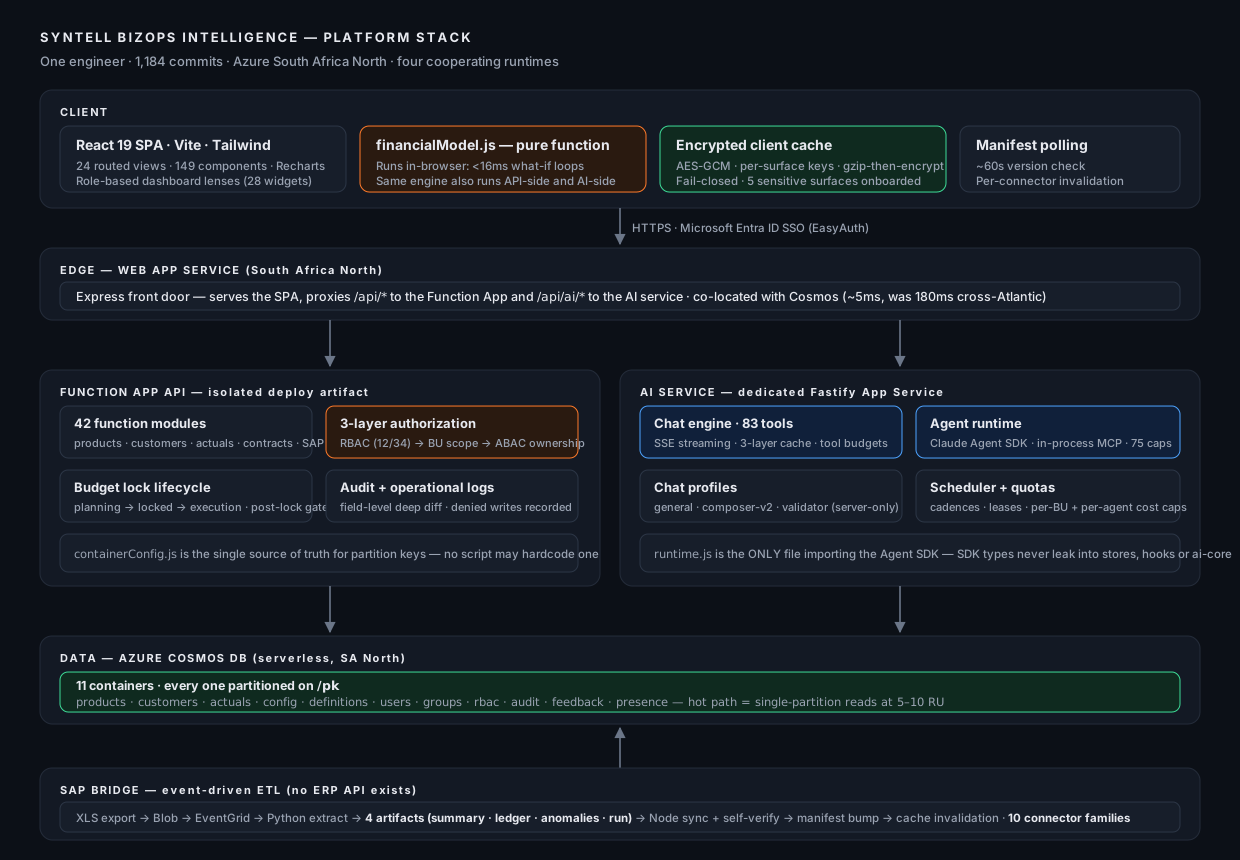
One calculation engine, three runtimes
Written on day one, before any UI, backend or database. It survived every refactor, three hosting migrations and a service extraction.
Why this matters for AI
The copilot does not estimate margin. It calls the same function the dashboard renders.There is exactly one definition of margin in this system — so the AI and the screen can never disagree.
The operating model
Product engineering · manufacturing · stock · procurement · contracts
This is the half of the platform people don't expect.
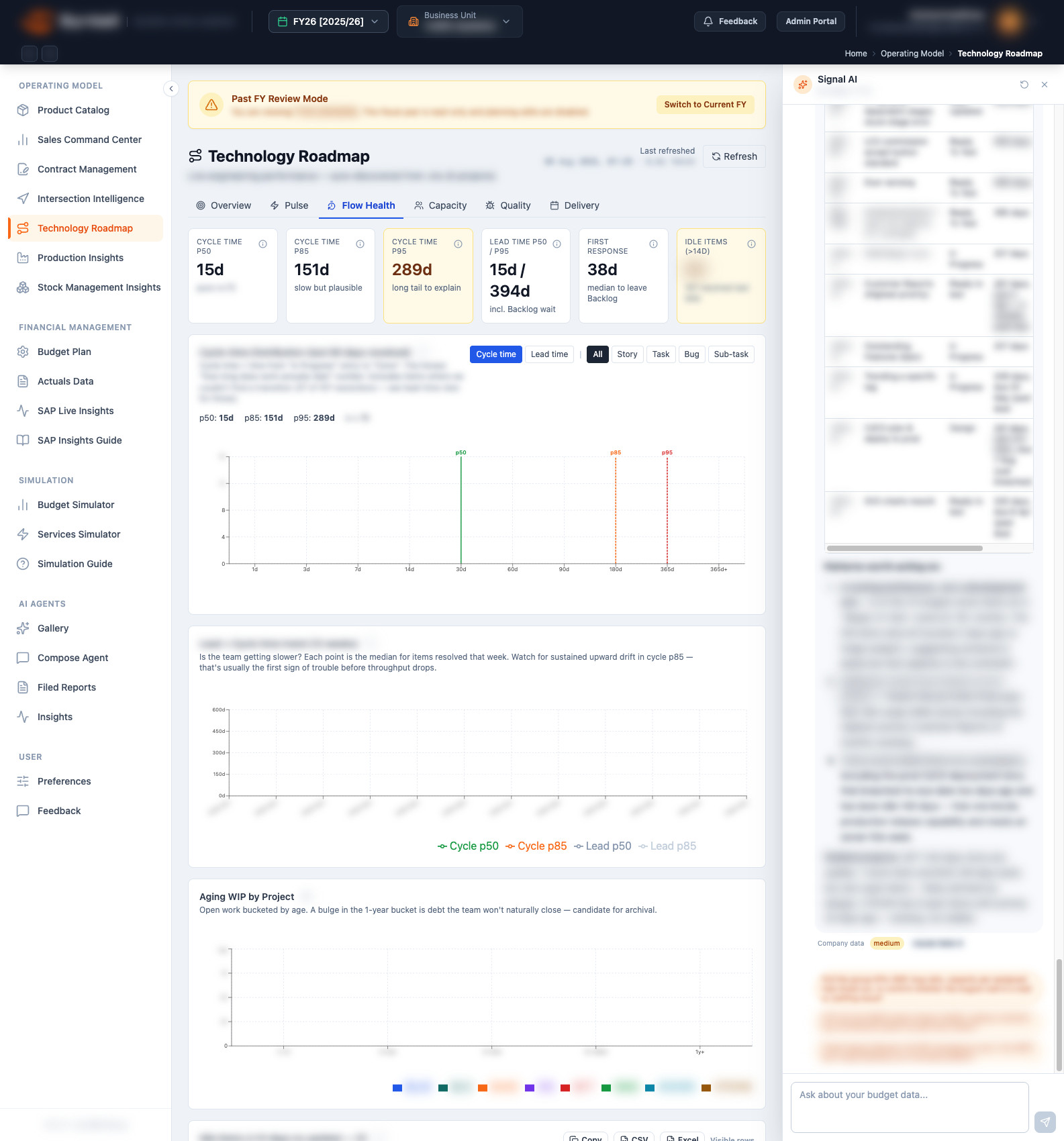
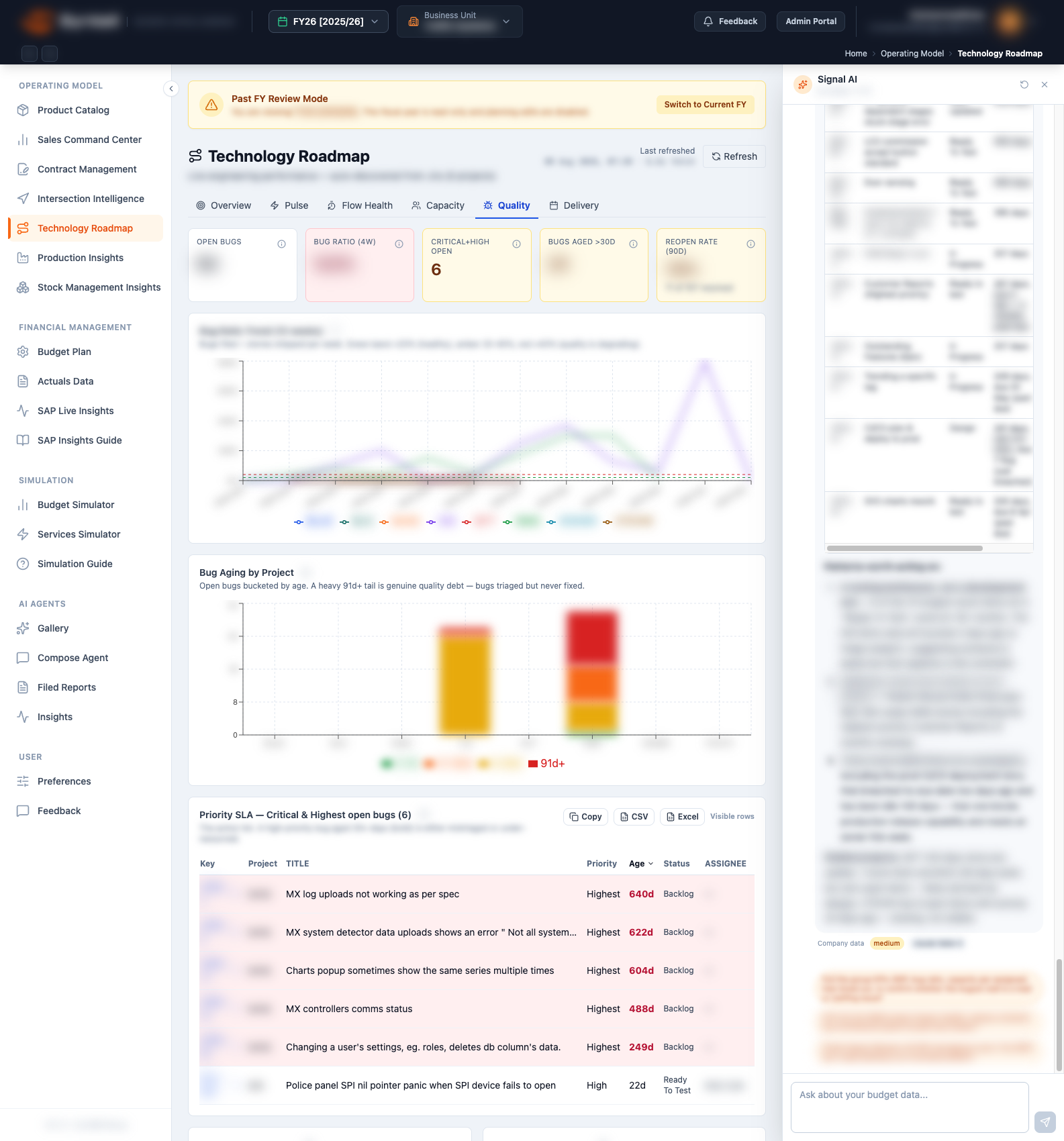
The roadmap is a data source, not a slide, six lenses, live from Jira
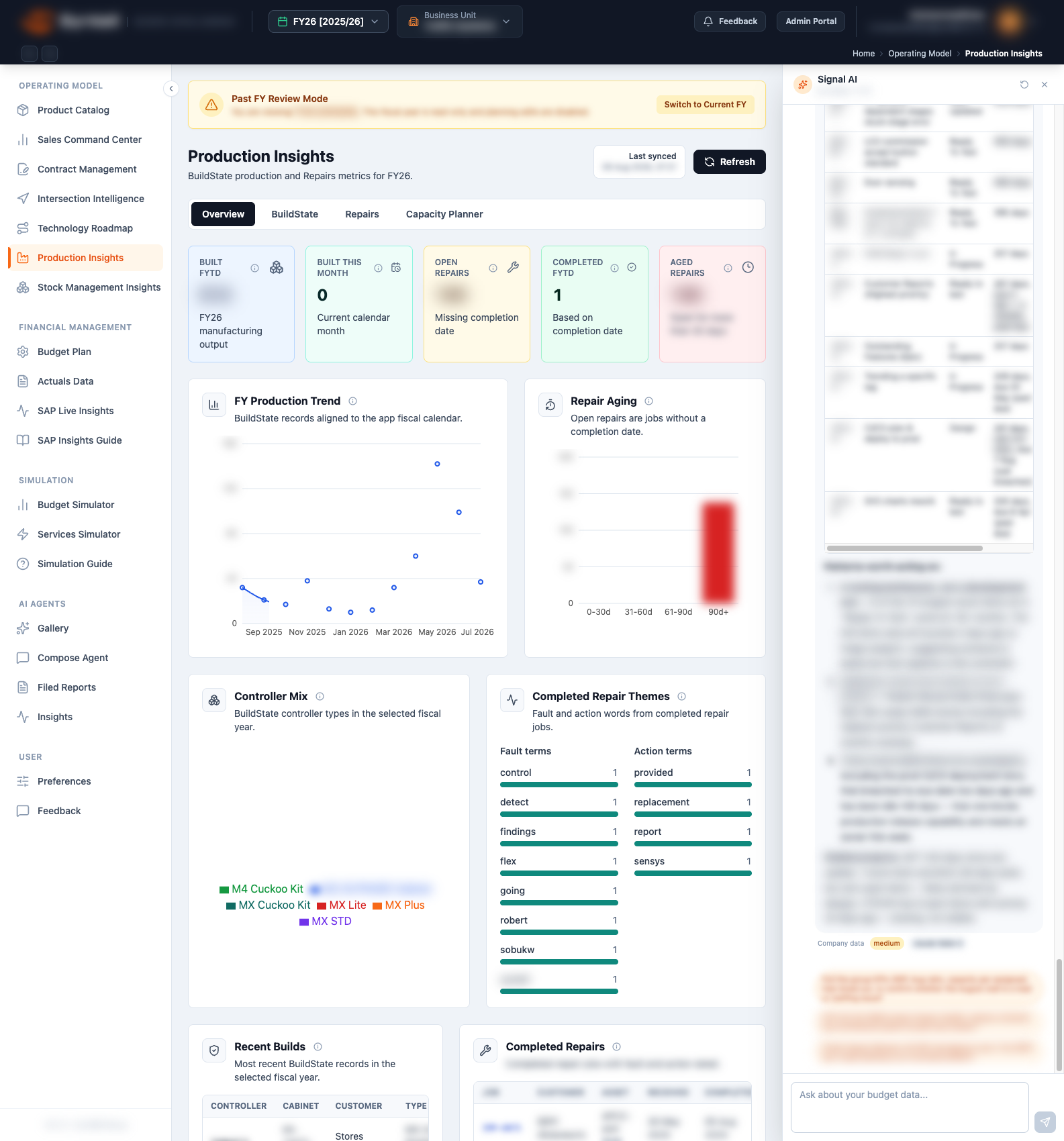
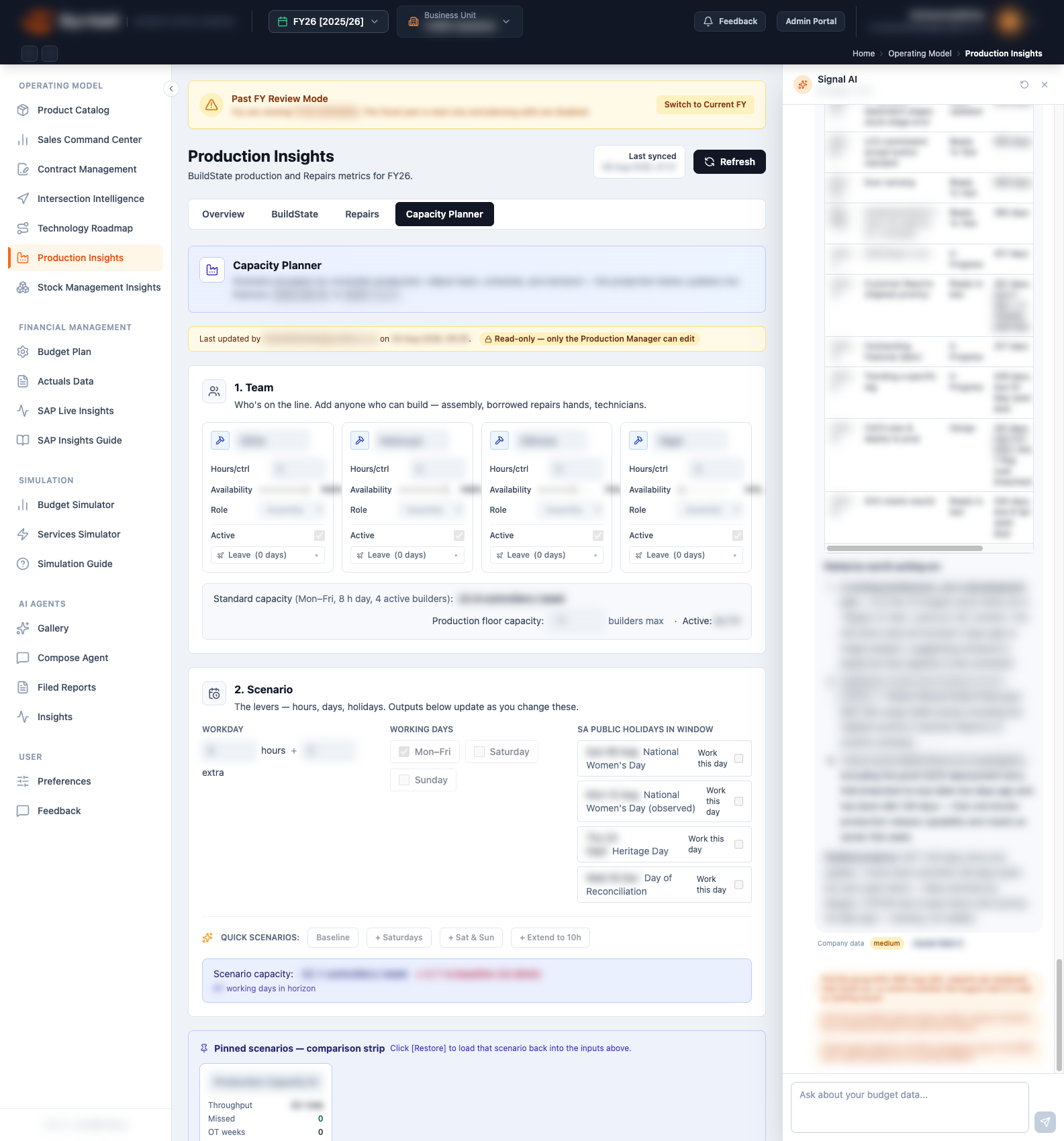
Overview · BuildState · Repairs · Capacity Planner
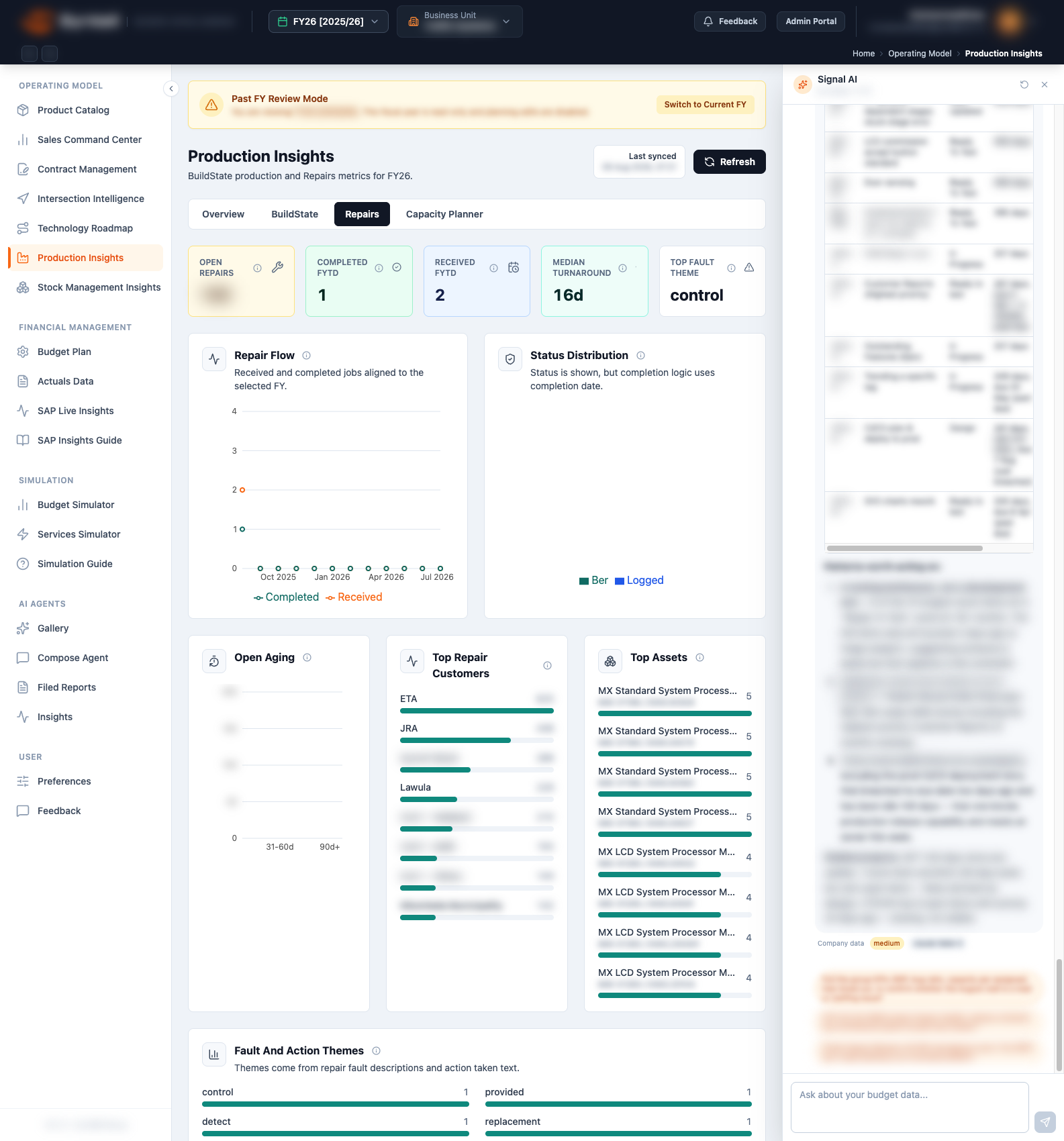
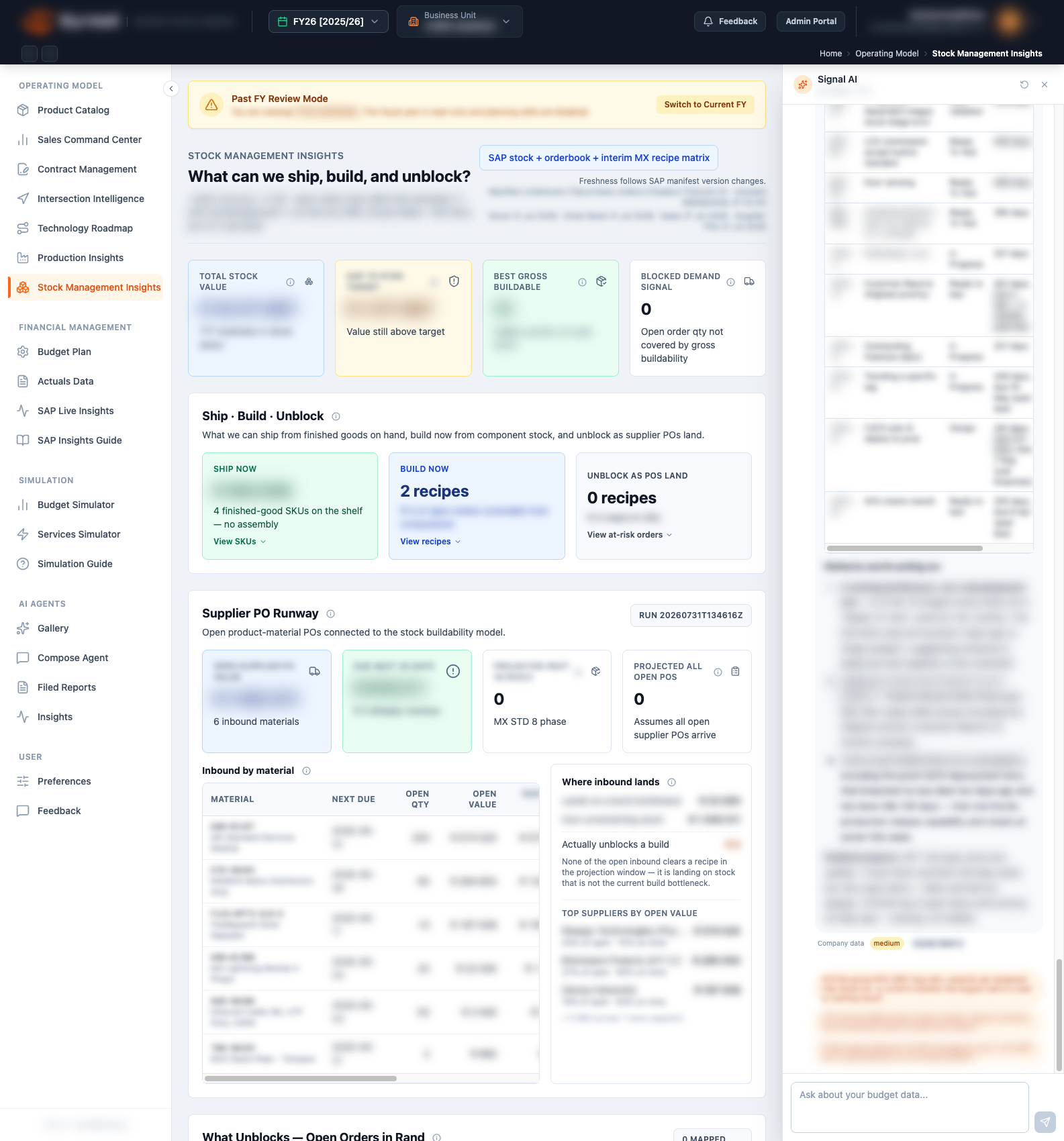
The order book is only real if you can build against it.
Three of the ten SAP connectors are procurement-side: purchase orders · PO lines · GRN receipts
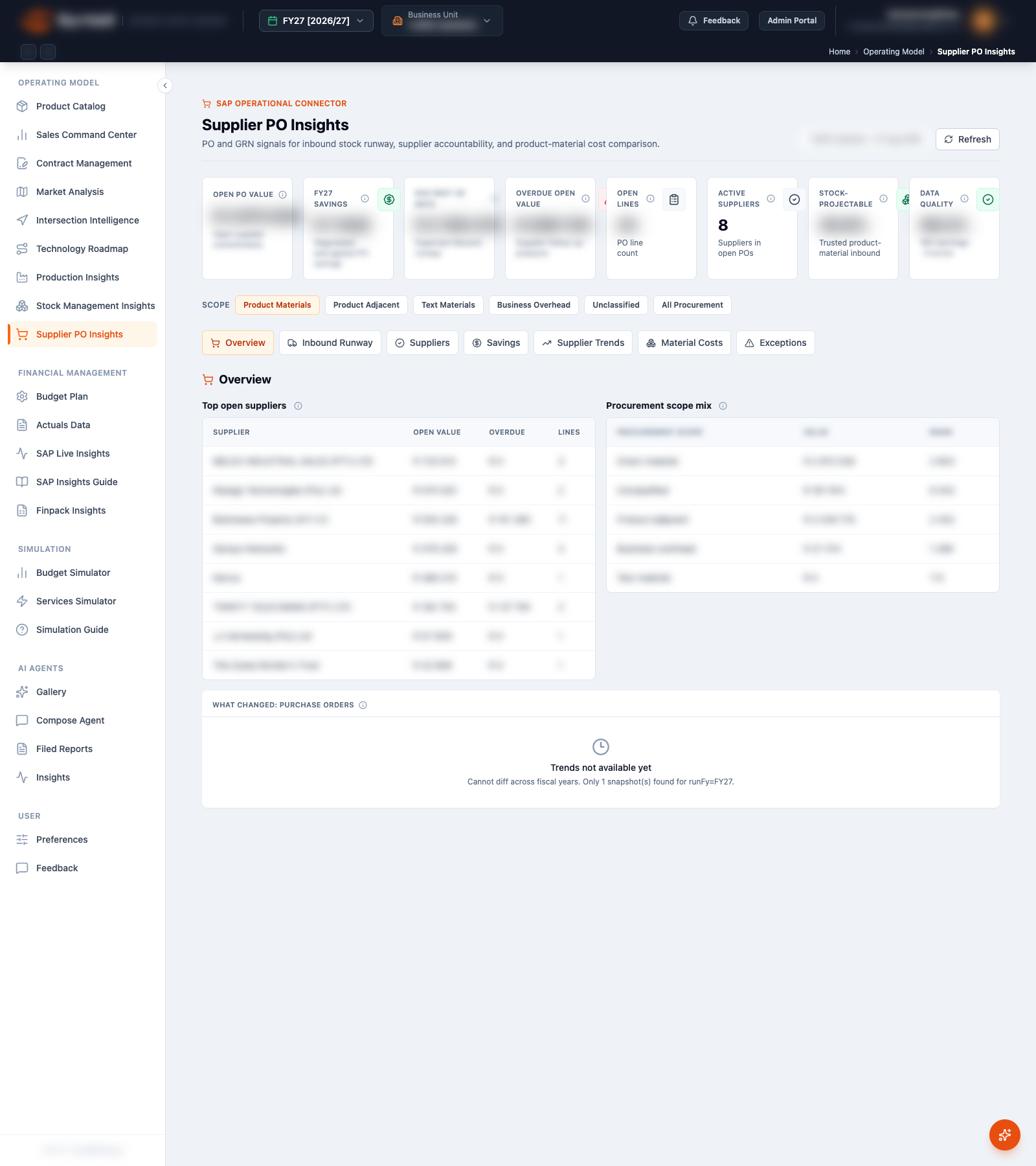
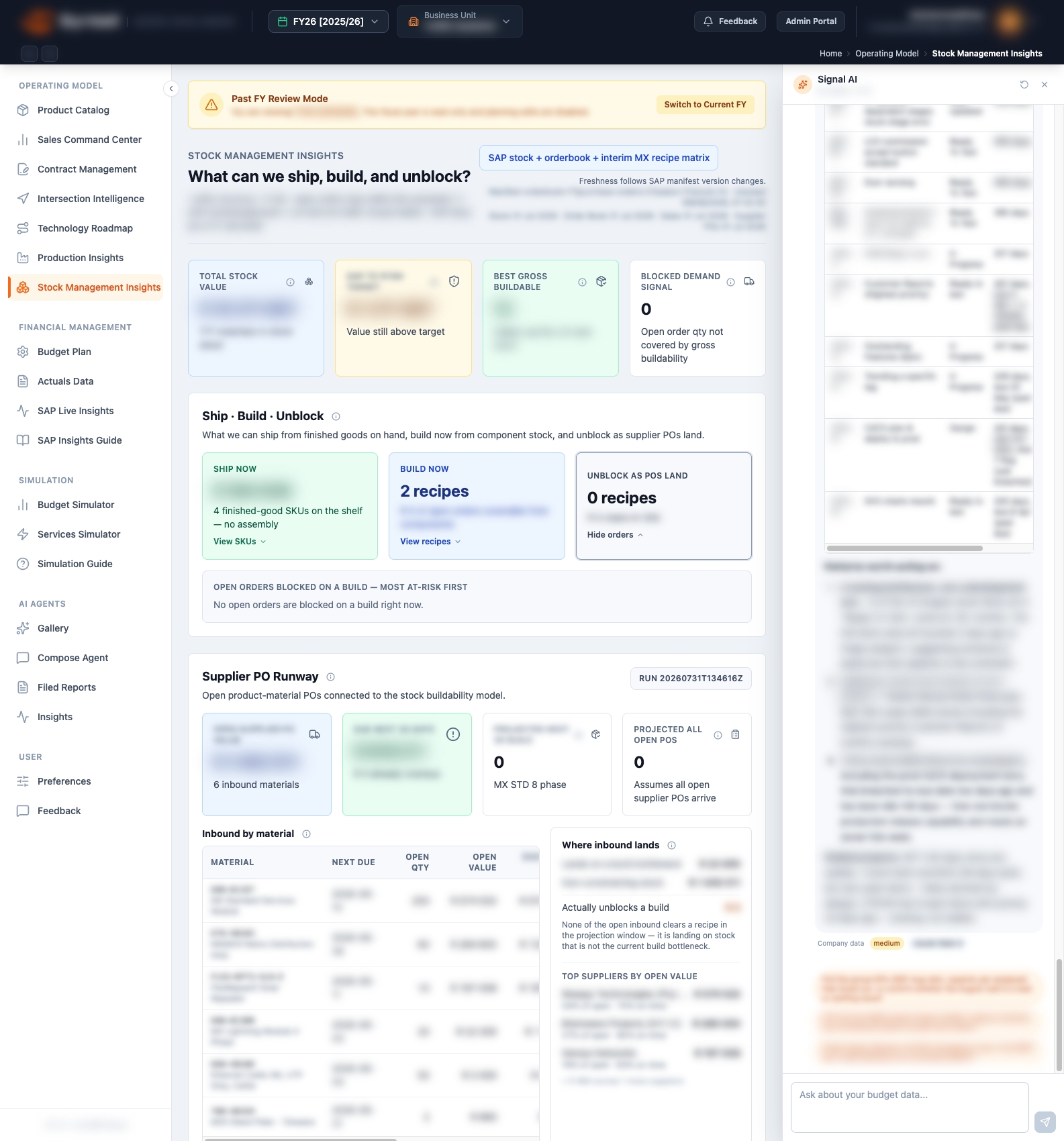
Procurement and manufacturing are the same question asked from two ends. The platform answers both from one dataset.
The Capacity Planner, the most operational surface in the platform
Multi-year client contracts, deliberately fiscal-year-agnostic
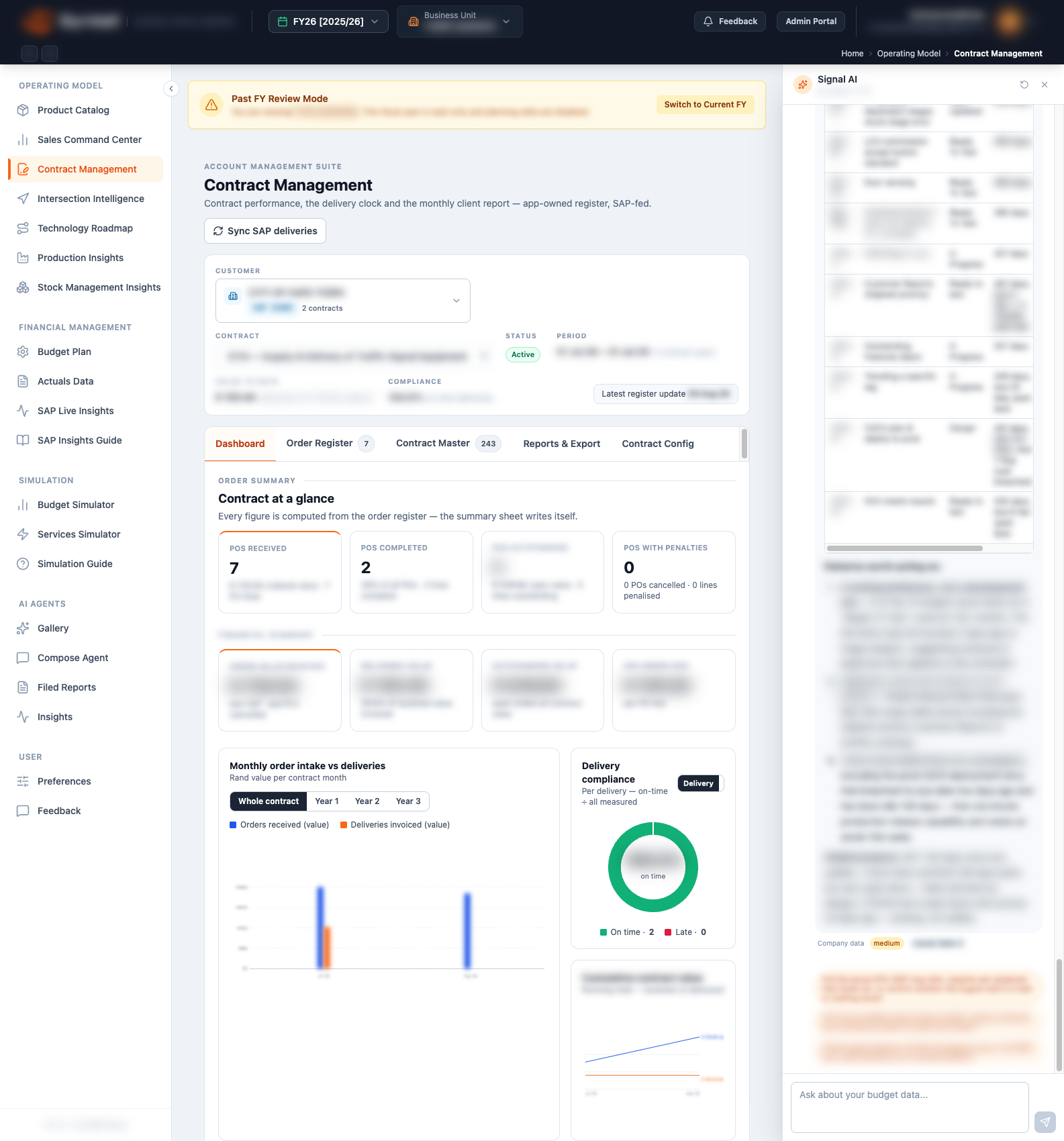
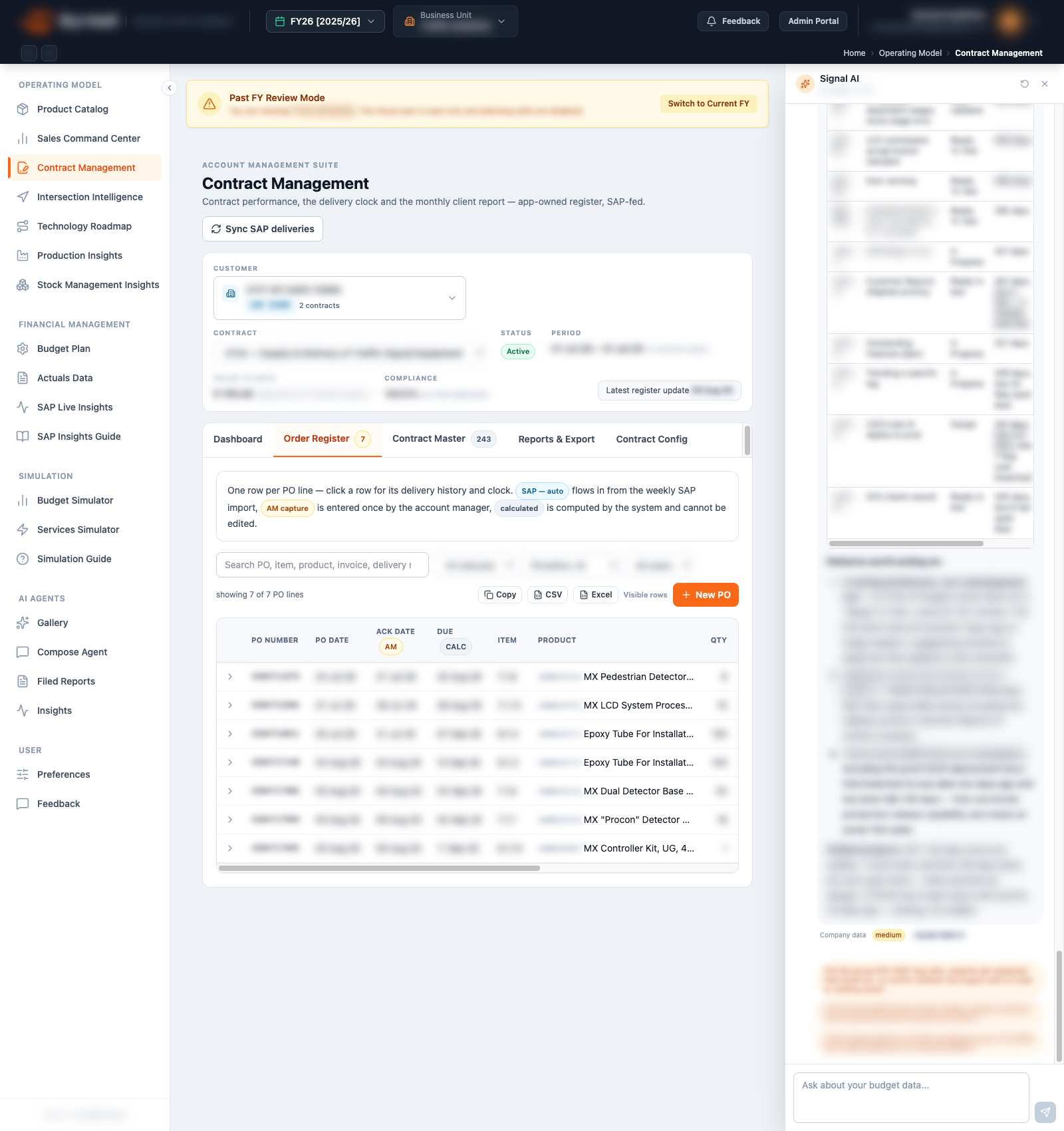
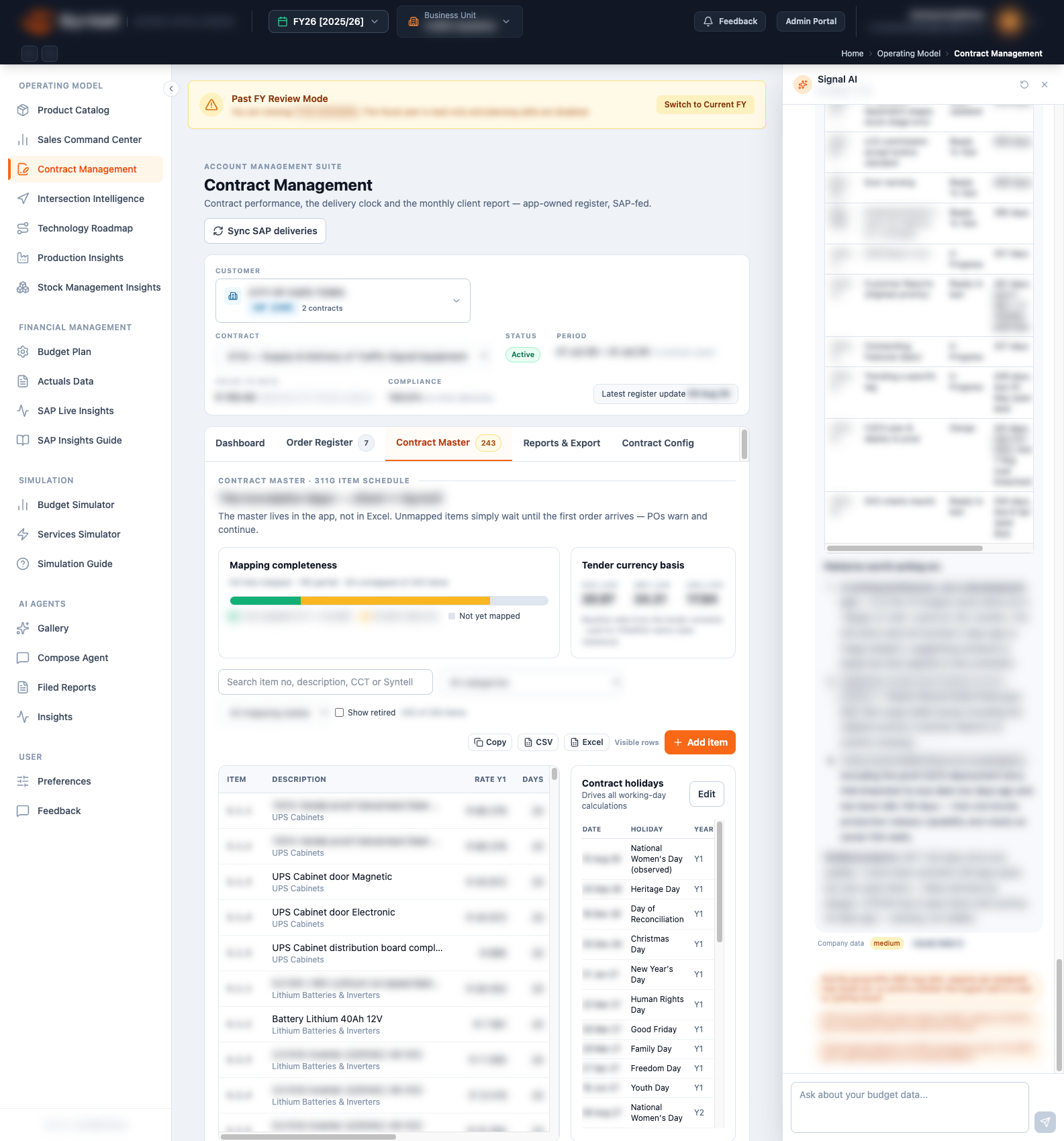
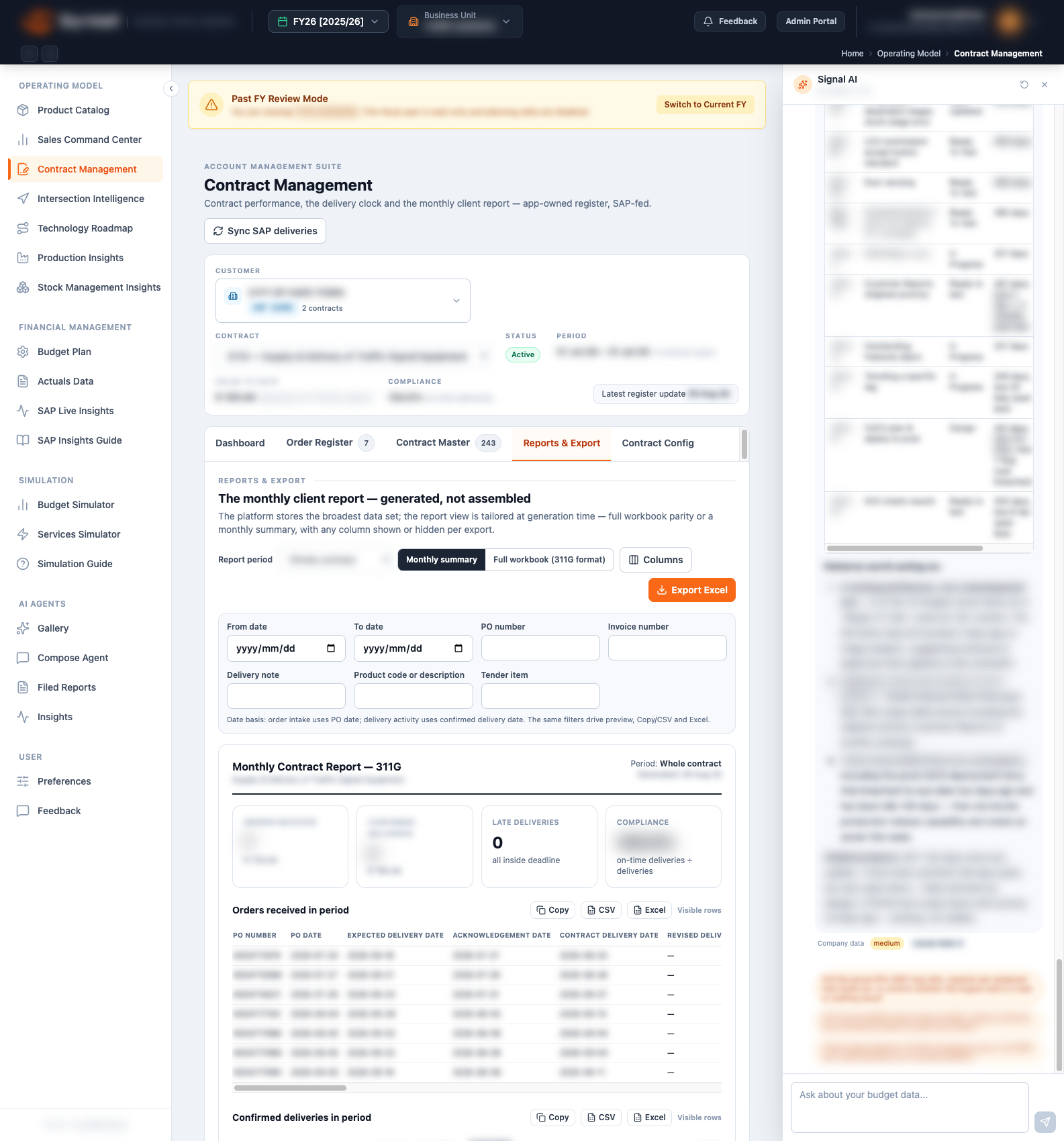
The bug that shows the rigour: the dashboard counted PO lines while labelling them POs, 528 lines vs 499 distinct PO documents, and penalties were counted per PO. The KPI block was silently mixing two grains.
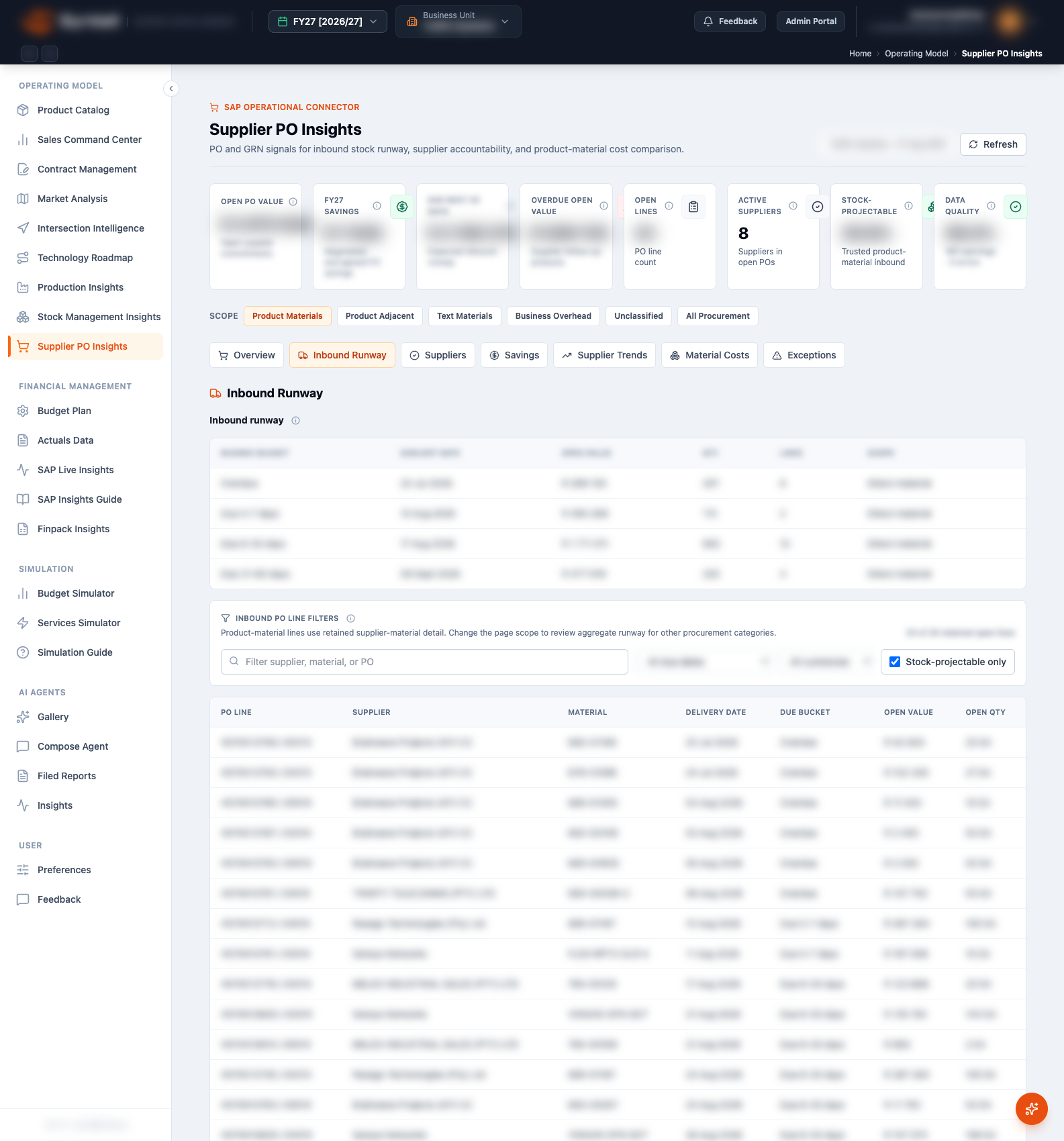
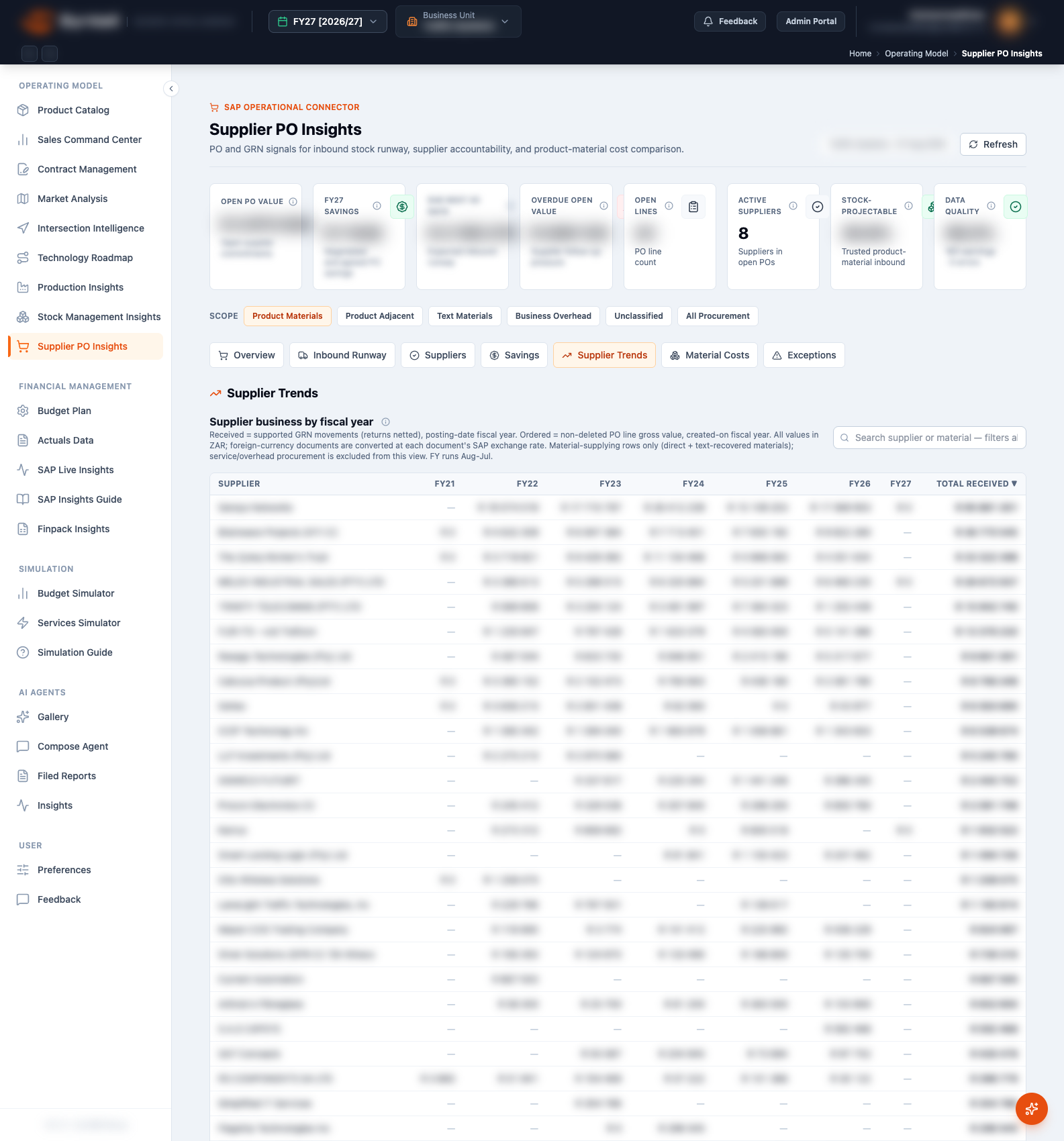
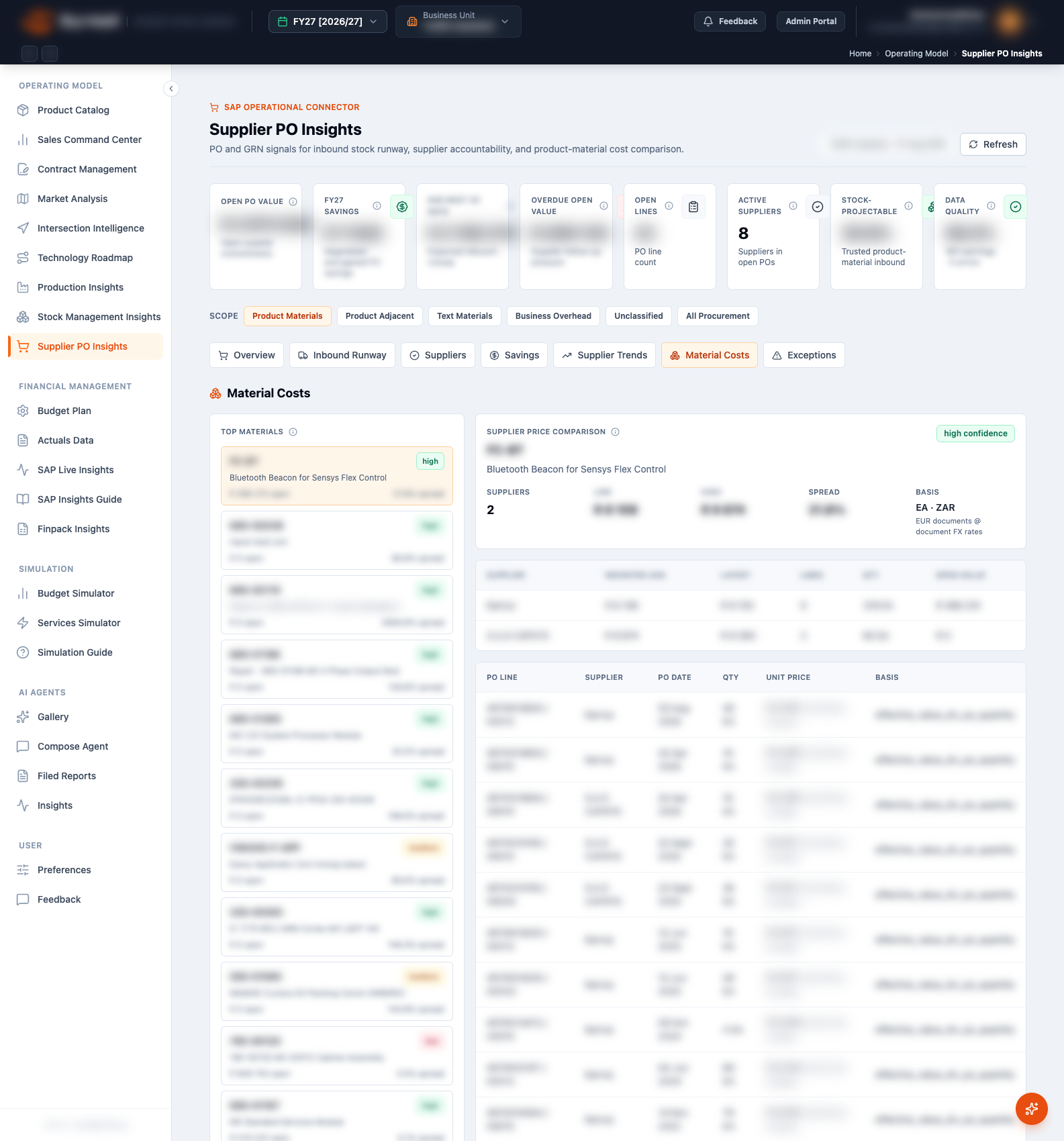
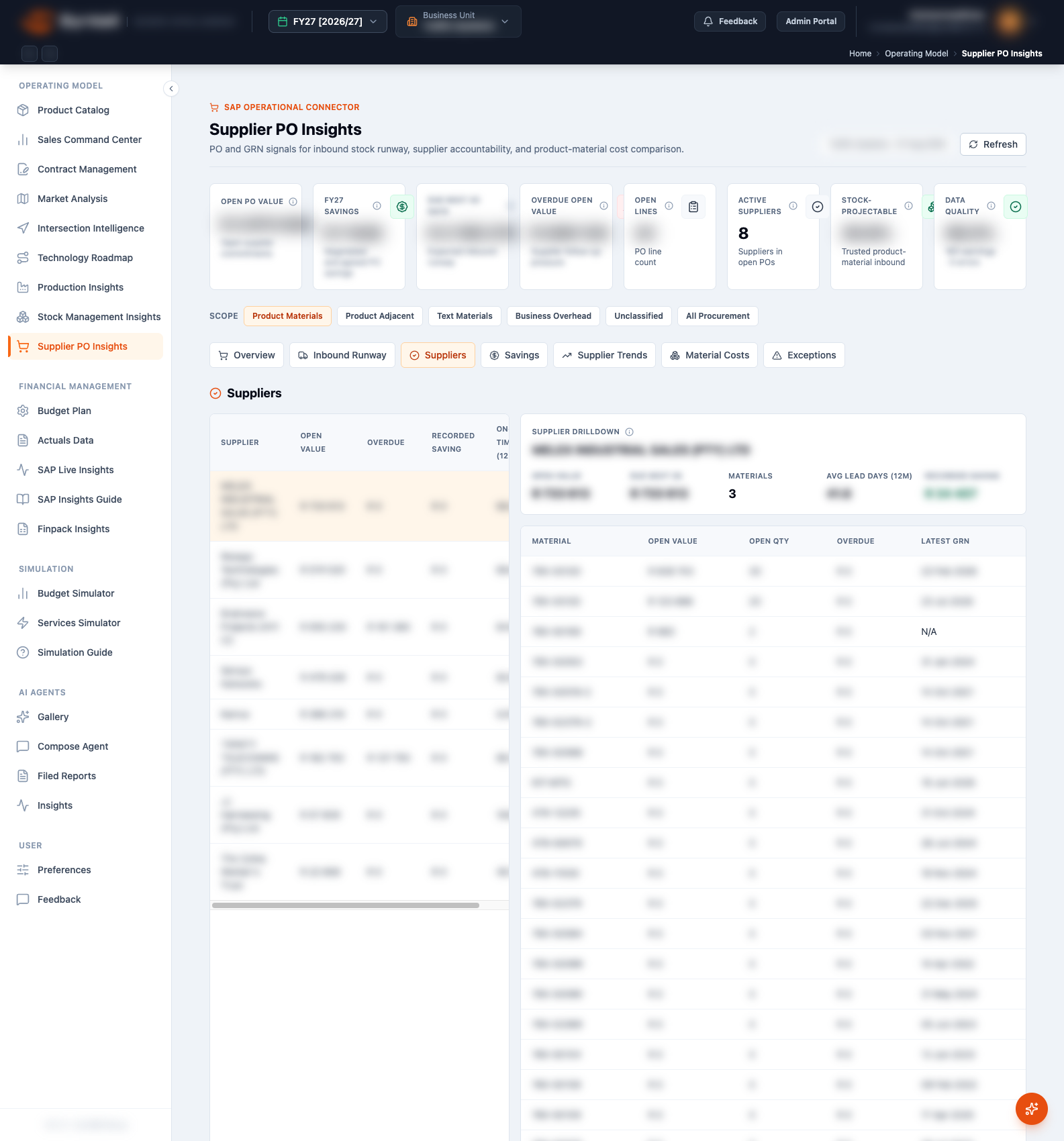
Supplier PO Insights — a suite, not a widget
Seven tabs — Overview · Inbound Runway · Suppliers · Savings · Supplier Trends · Material Costs · Exceptions — over purchase orders, PO lines and GRN receipts.
Where the supply side becomes a decision
FinPack — a real management-accounts pack
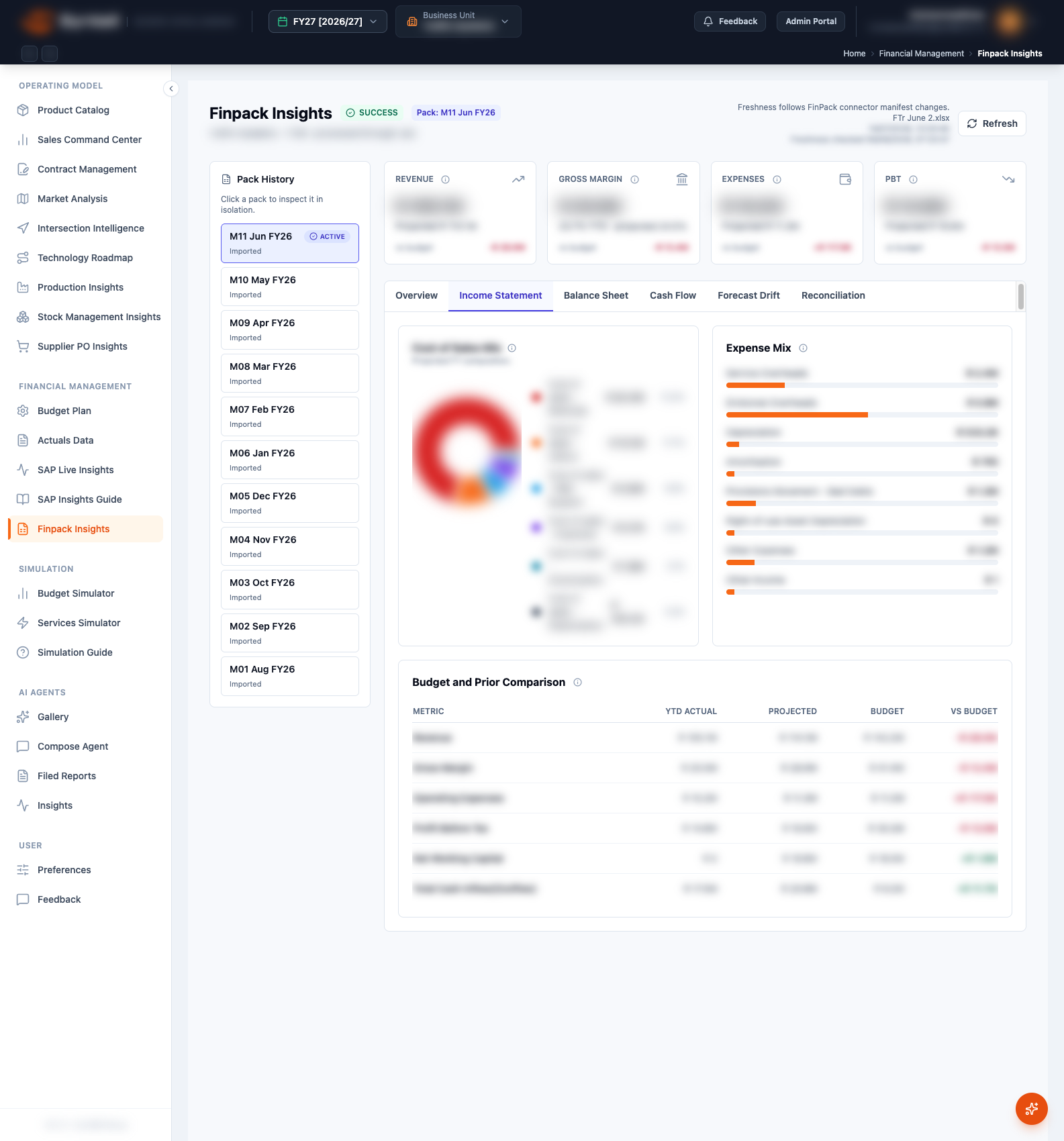
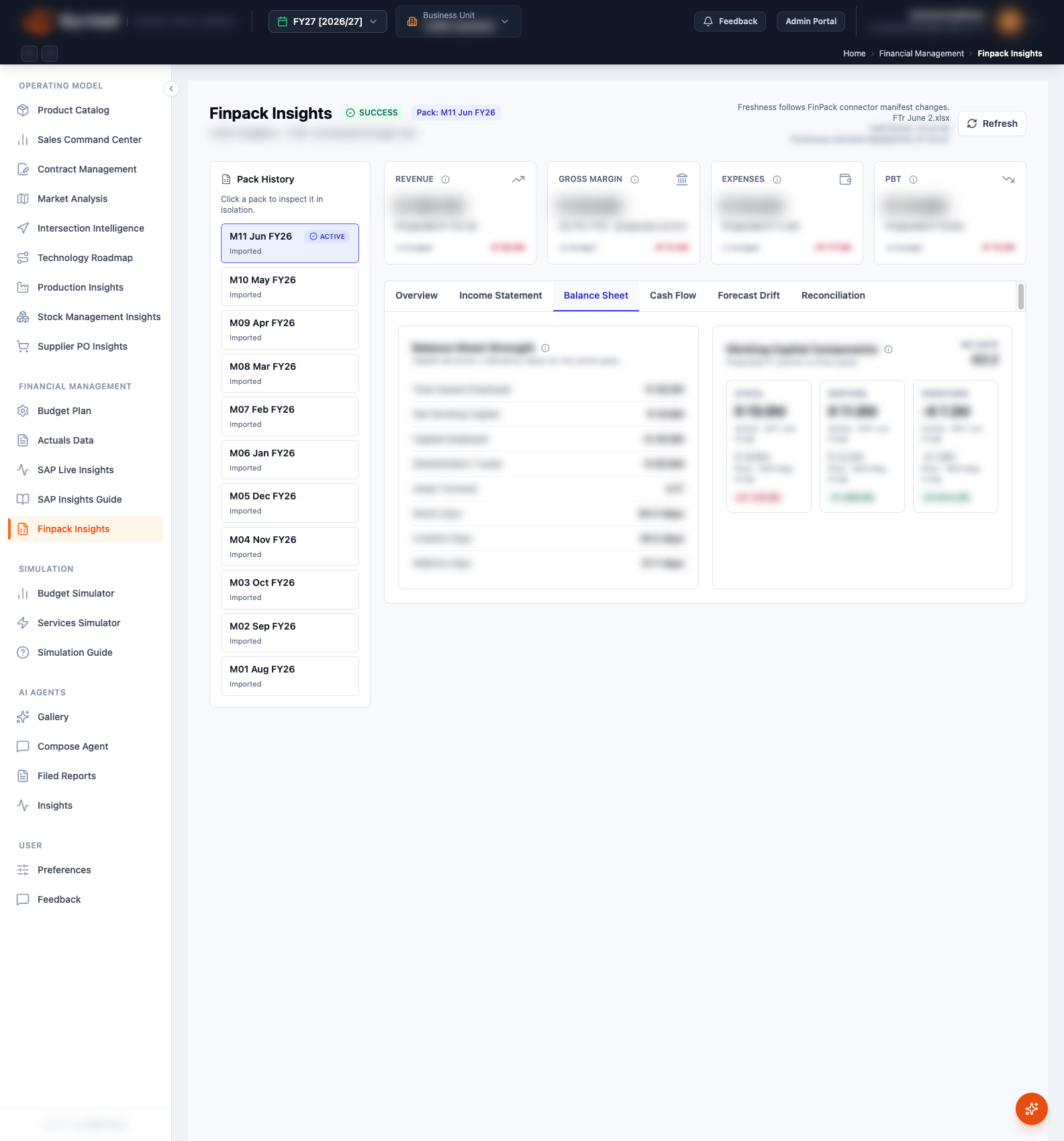
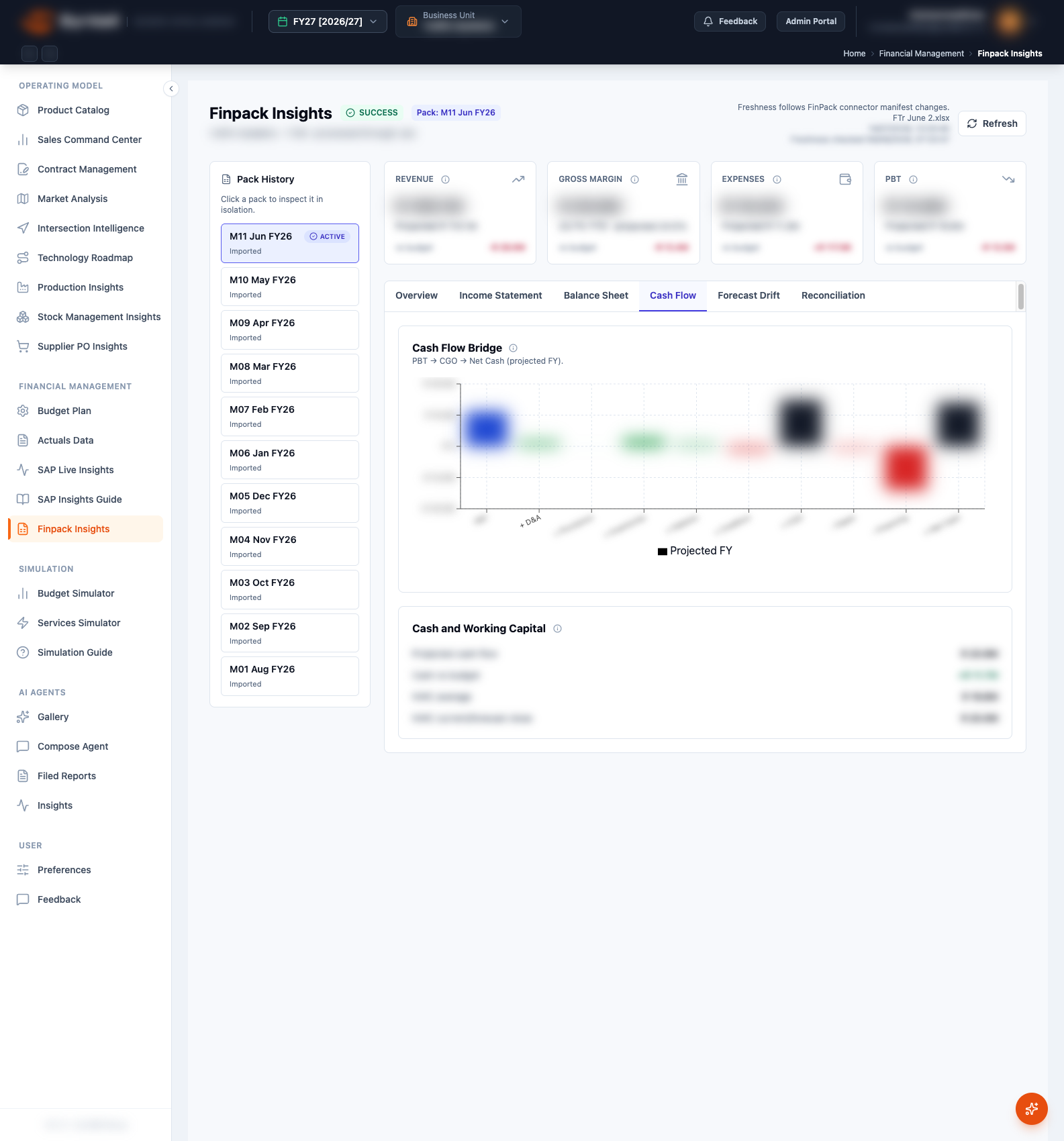
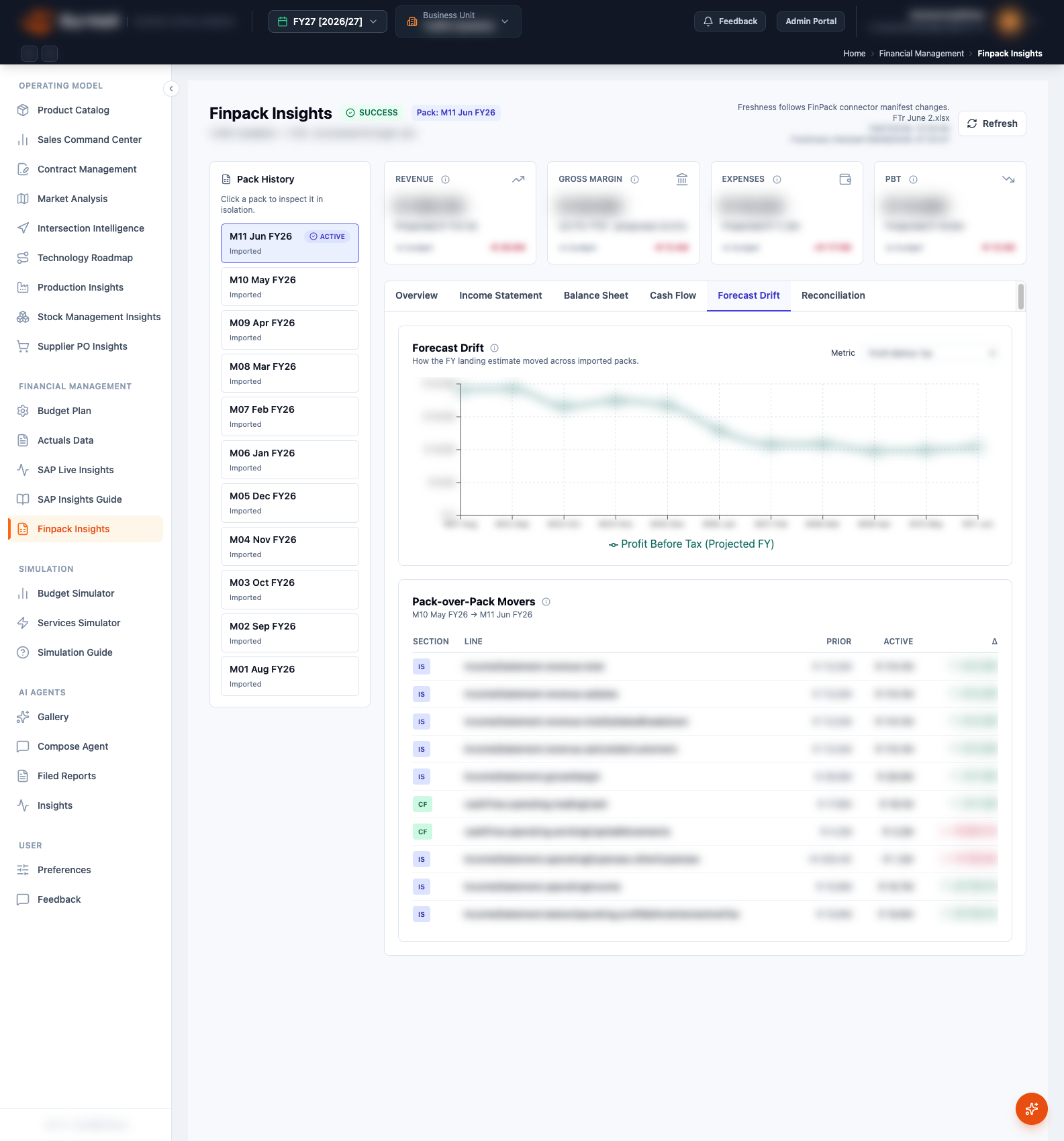
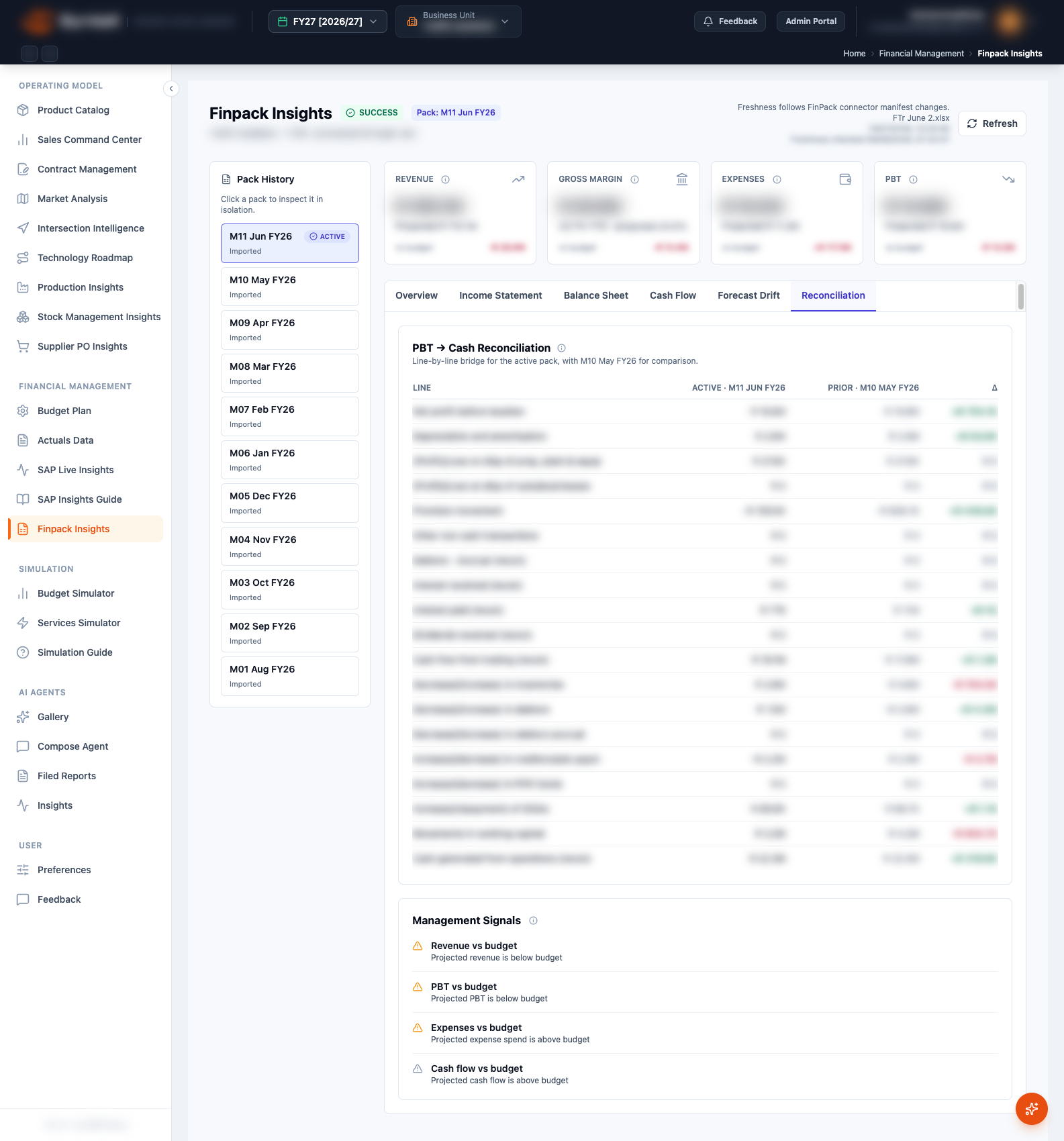
FinPack is declared authoritative for PBT in the shared grounding — so neither the copilot nor an agent may quote a PBT figure from anywhere else.
The financial spine
Plan · simulate · actuals · the official monthly pack
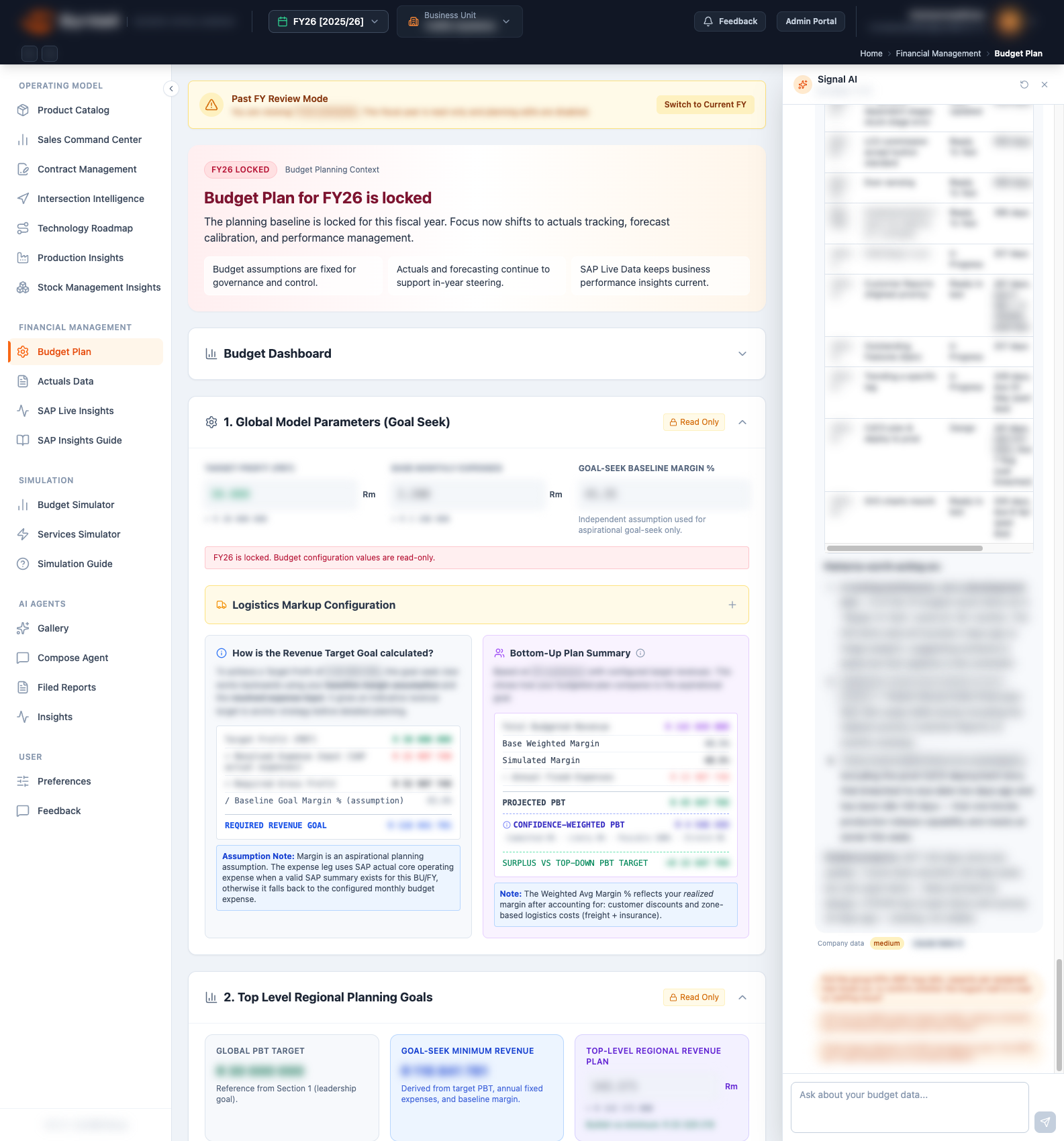
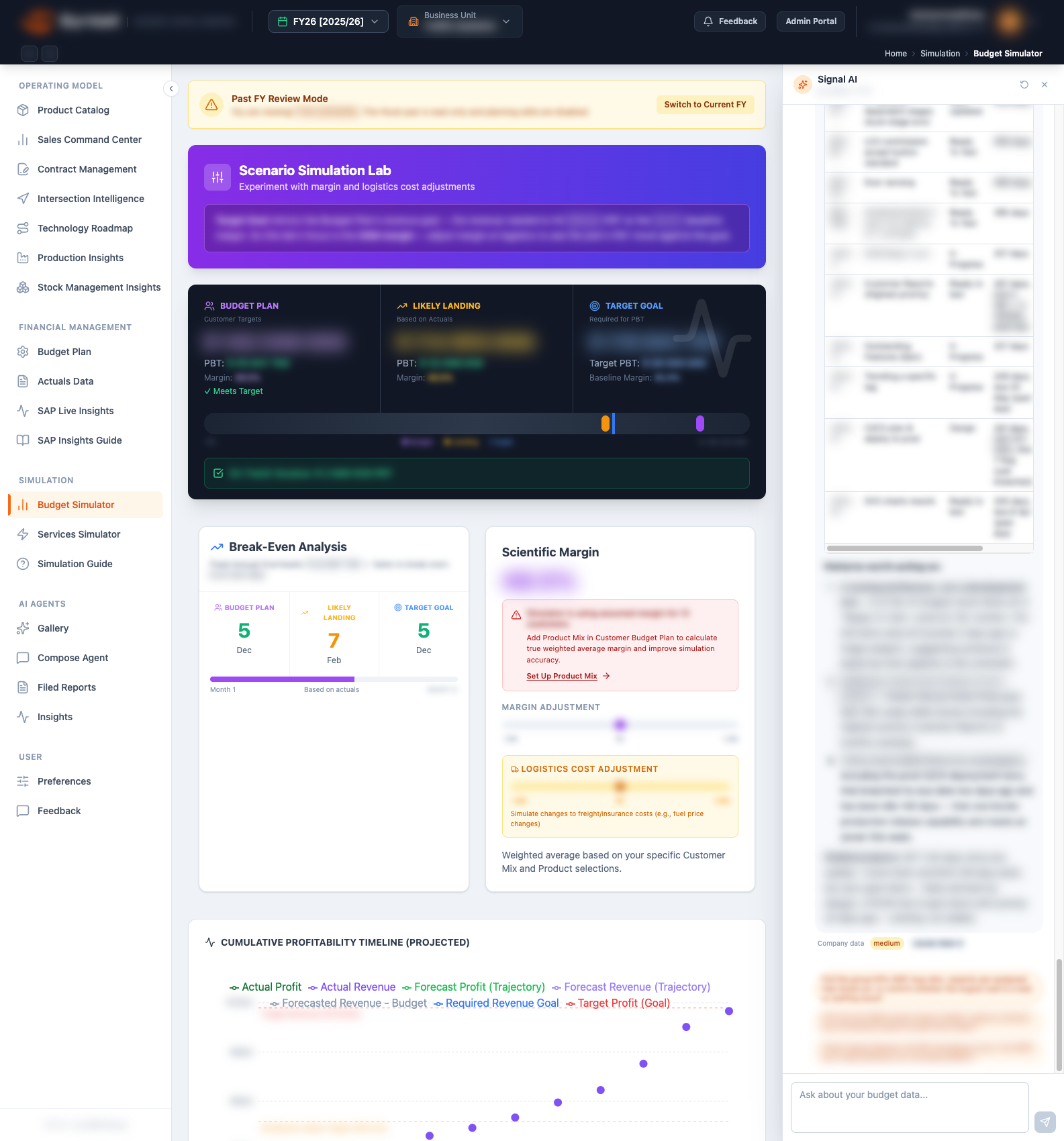
The official monthly management pack
The strictest surface in the platform gets its own tool family:
Why explain_finpack_drift matters
At month-end the useful question is never "what is the number".It is "what moved, and why".
A pack that can explain its own drift against the prior month is a different artefact from a pack that merely states a total.
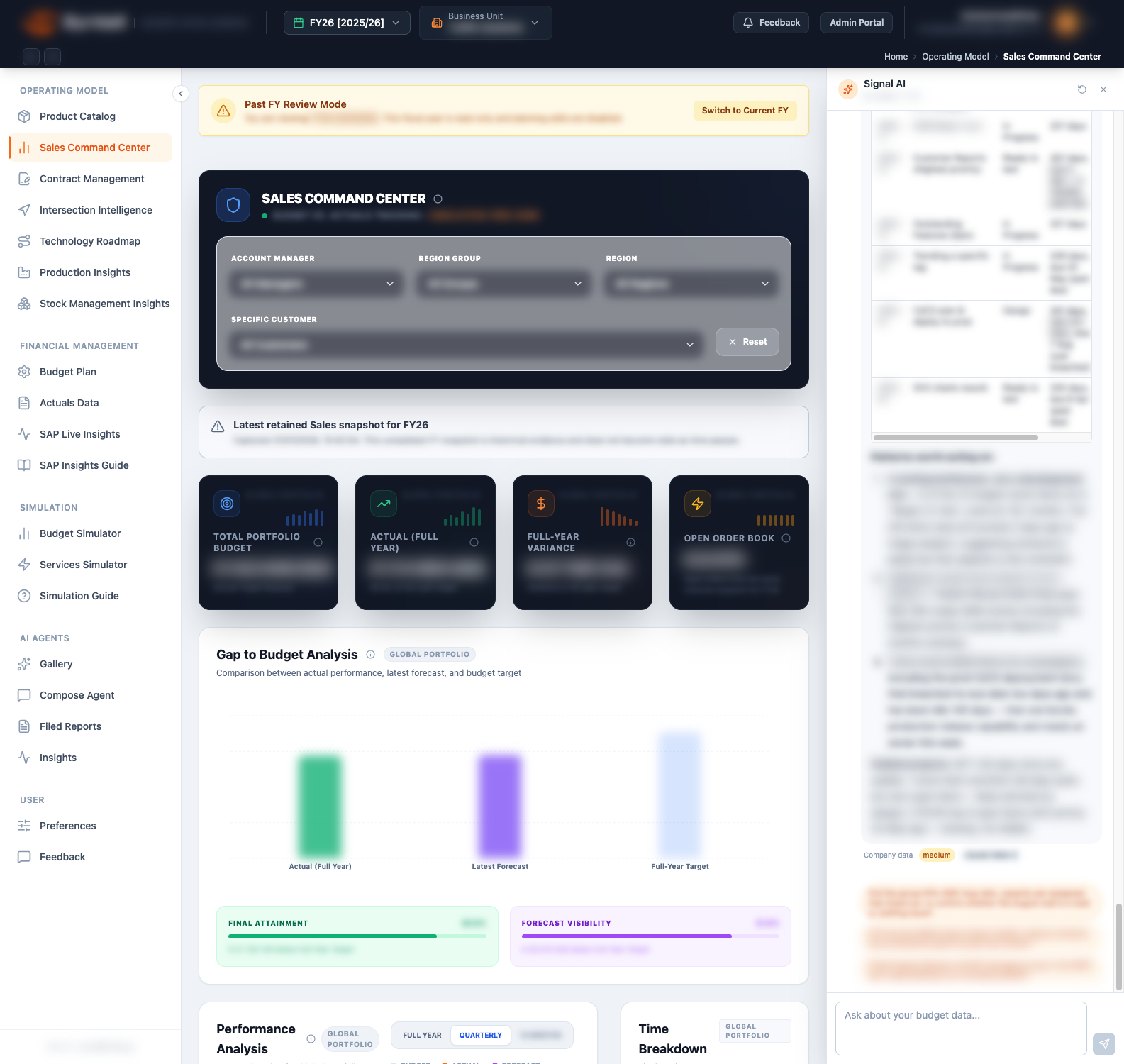
Sales Command Center
One place to inspect an account portfolio —
and to hold it to account
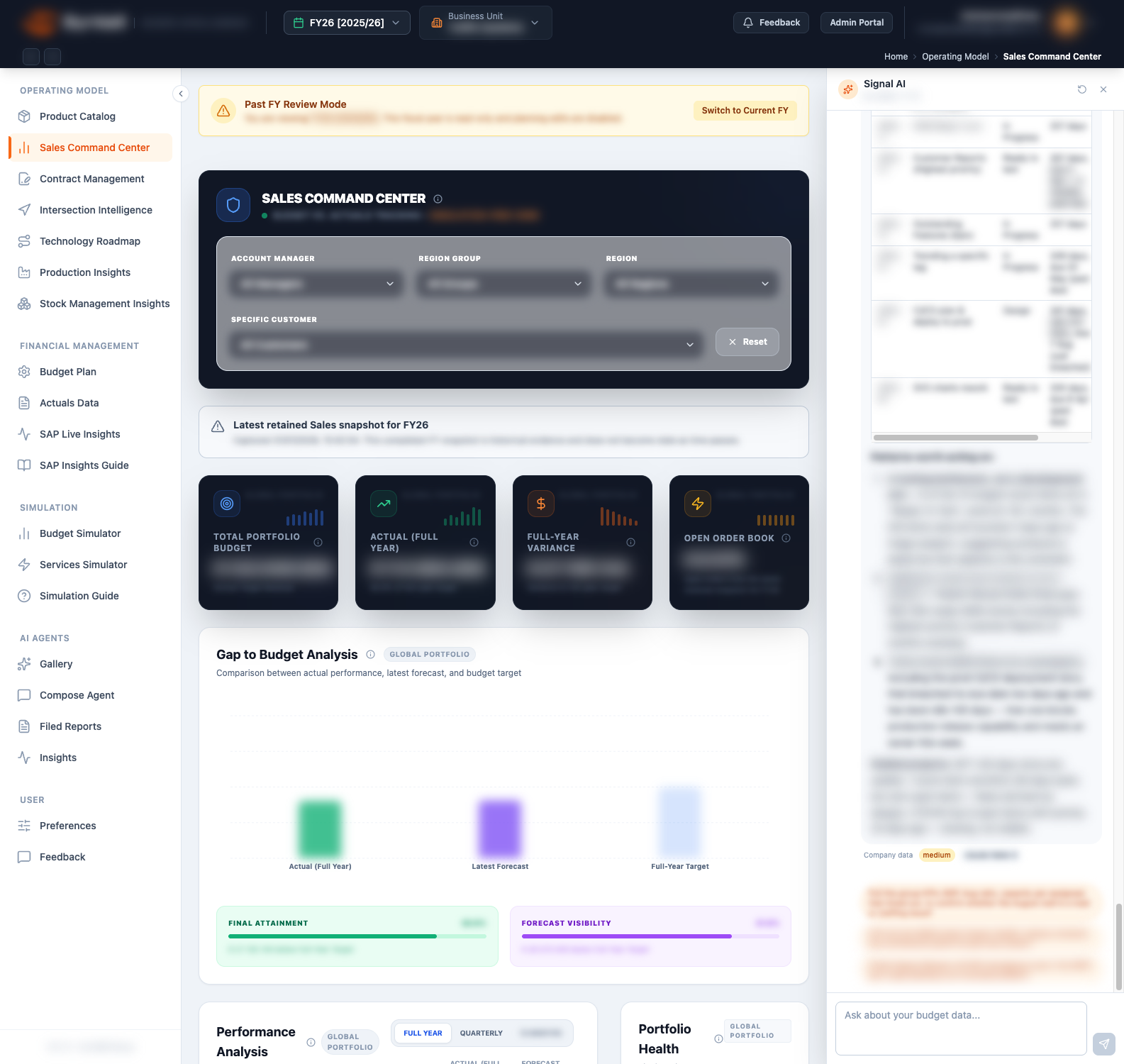
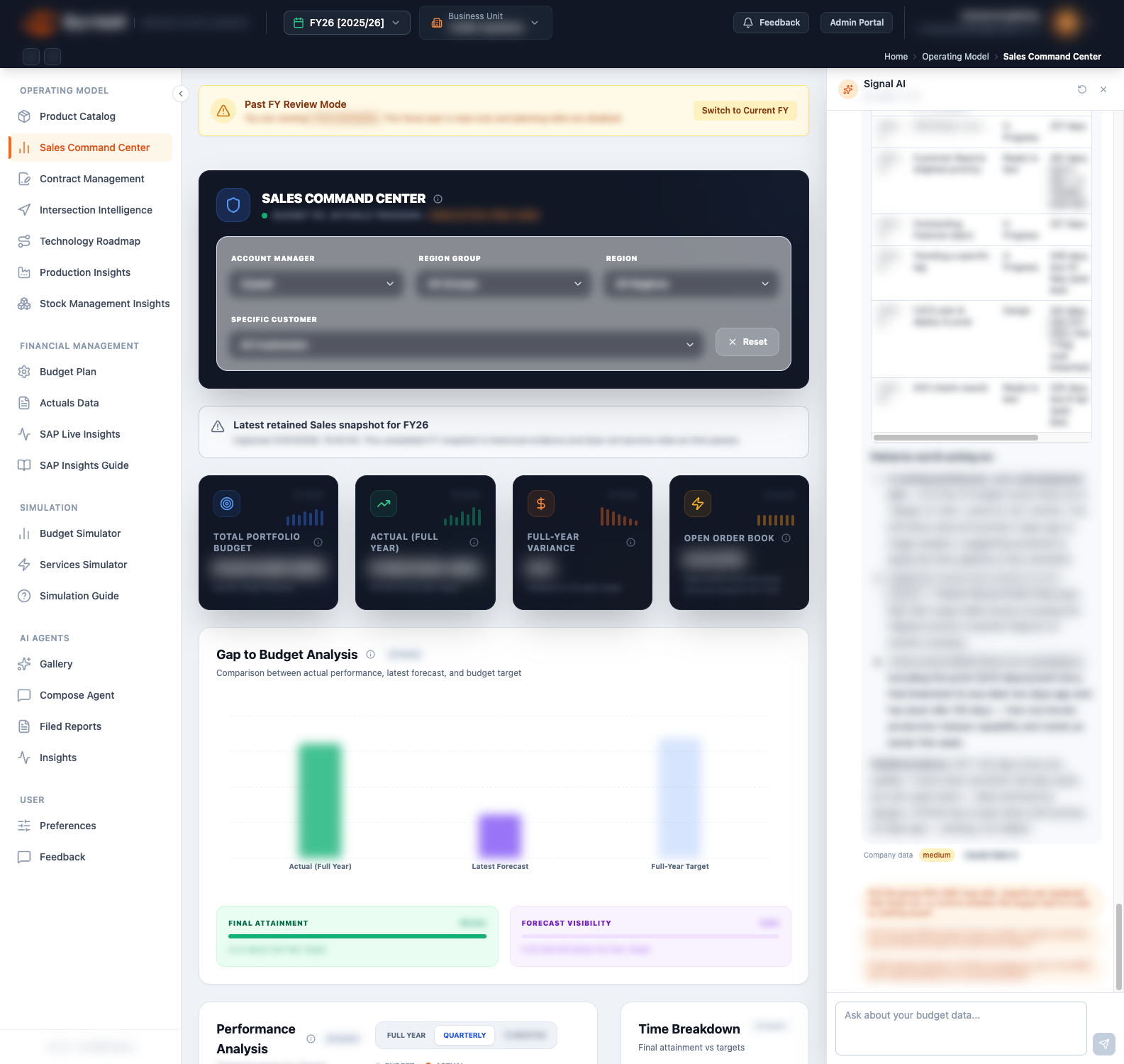
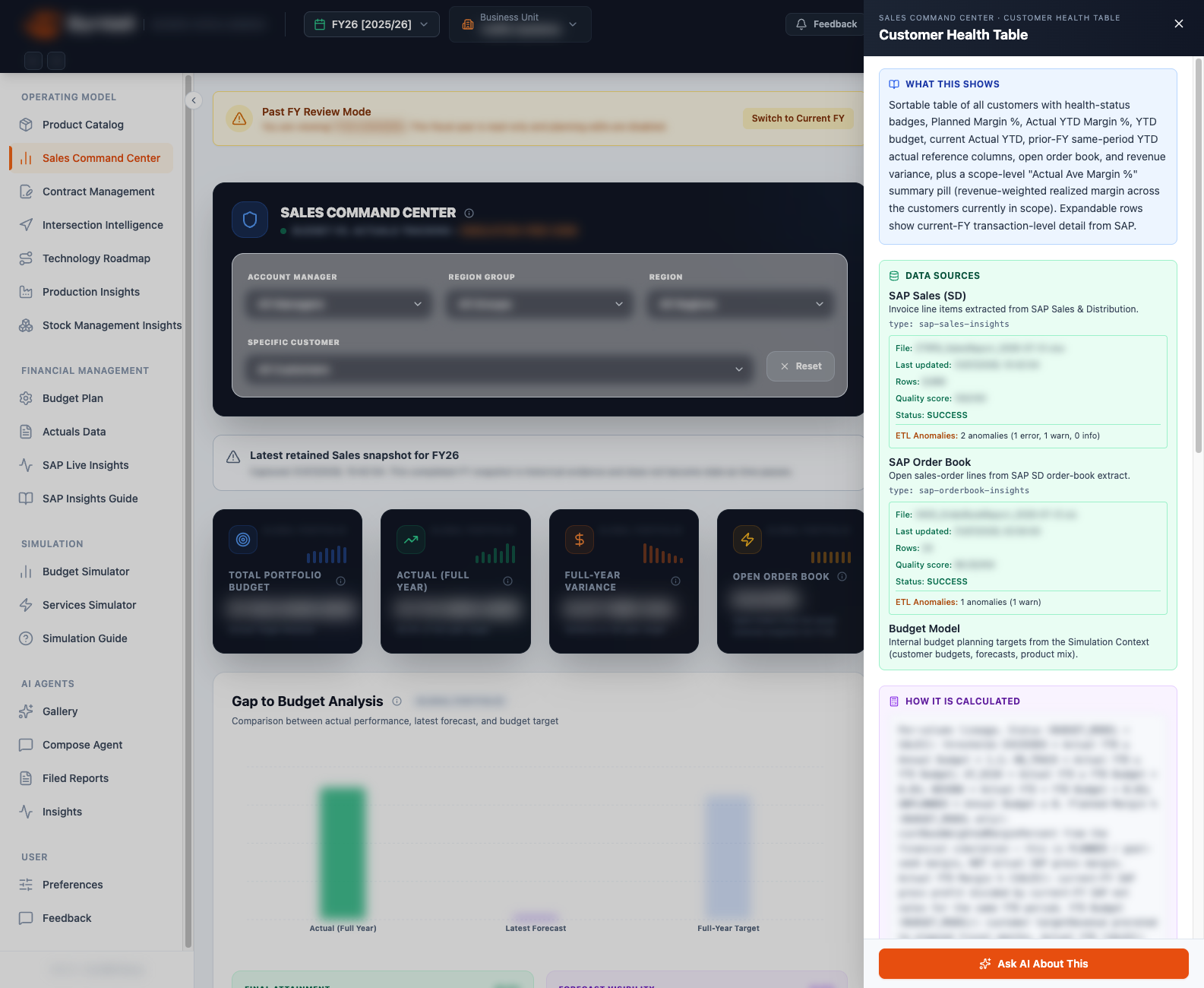
One filter bar re-scopes the entire page
Four hero KPIs — Total Portfolio Budget · Actual (Full Year) · Full-Year Variance · Open Order Book — then seven analytical sections, all scope-aware.
Why this matters organisationally
The GM and the account manager look at the same page, not two different reports that disagree.A portfolio review stops being "send me your numbers" and becomes "let's both look at the same scope."
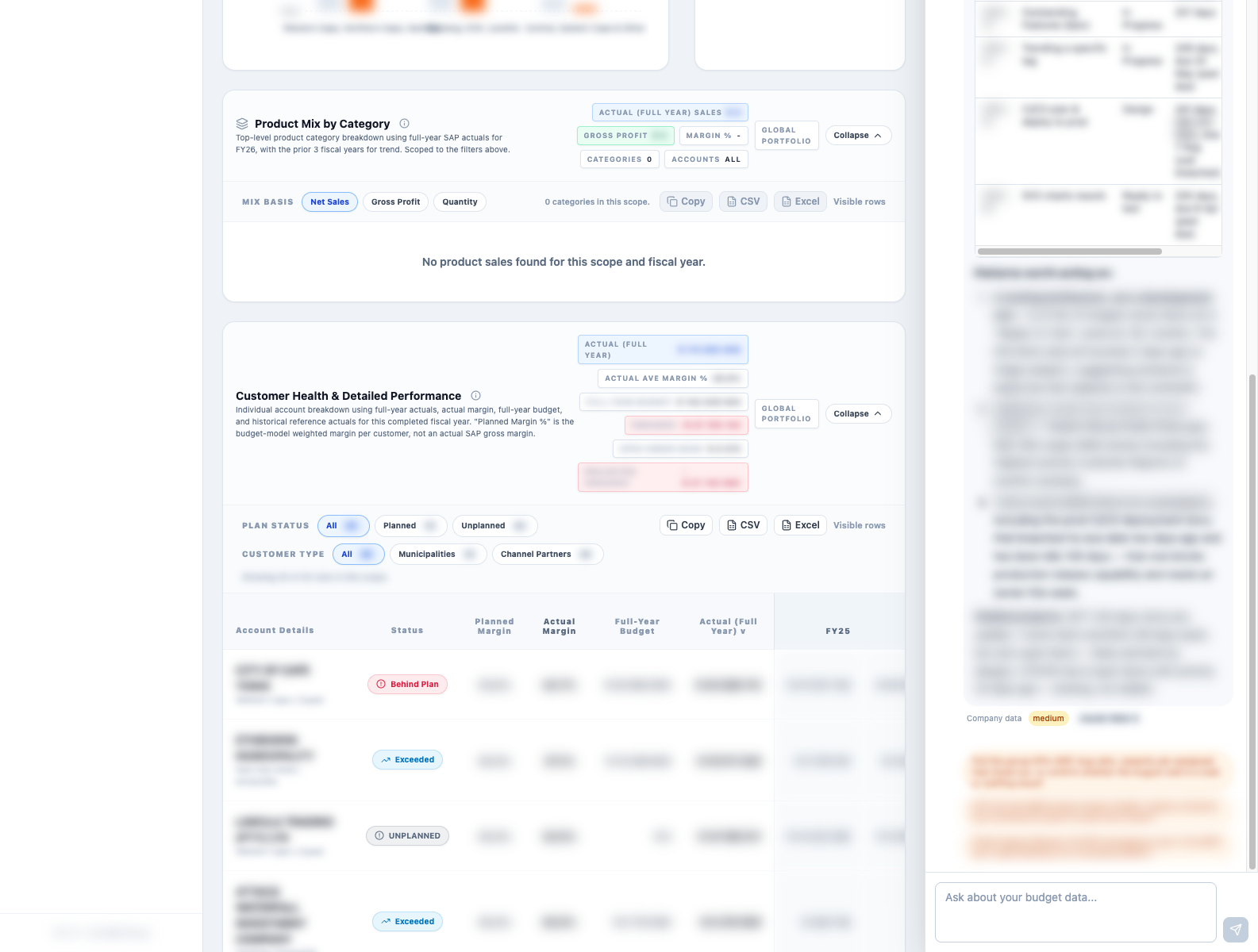
Customer Health & Detailed Performance, the account manager's working list
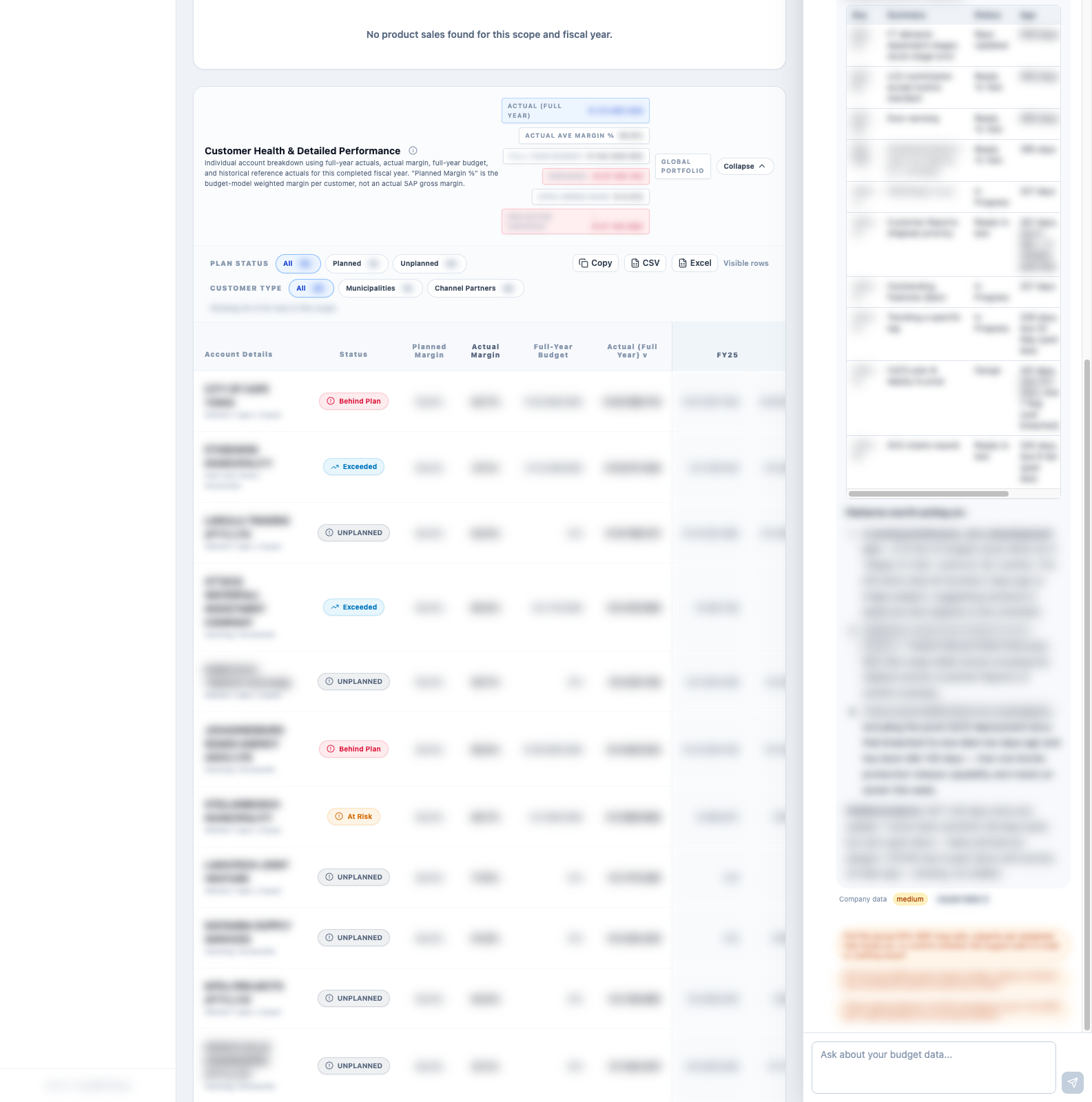
Status badges — Behind Plan · At Risk · Exceeded · Unplanned — beside Planned Margin vs Actual Margin, full-year budget, actual, three years of history, open order book and variance. Filterable by plan status and customer type; exportable to Copy / CSV / Excel.
The same portfolio, four ways, because the question changes the shape
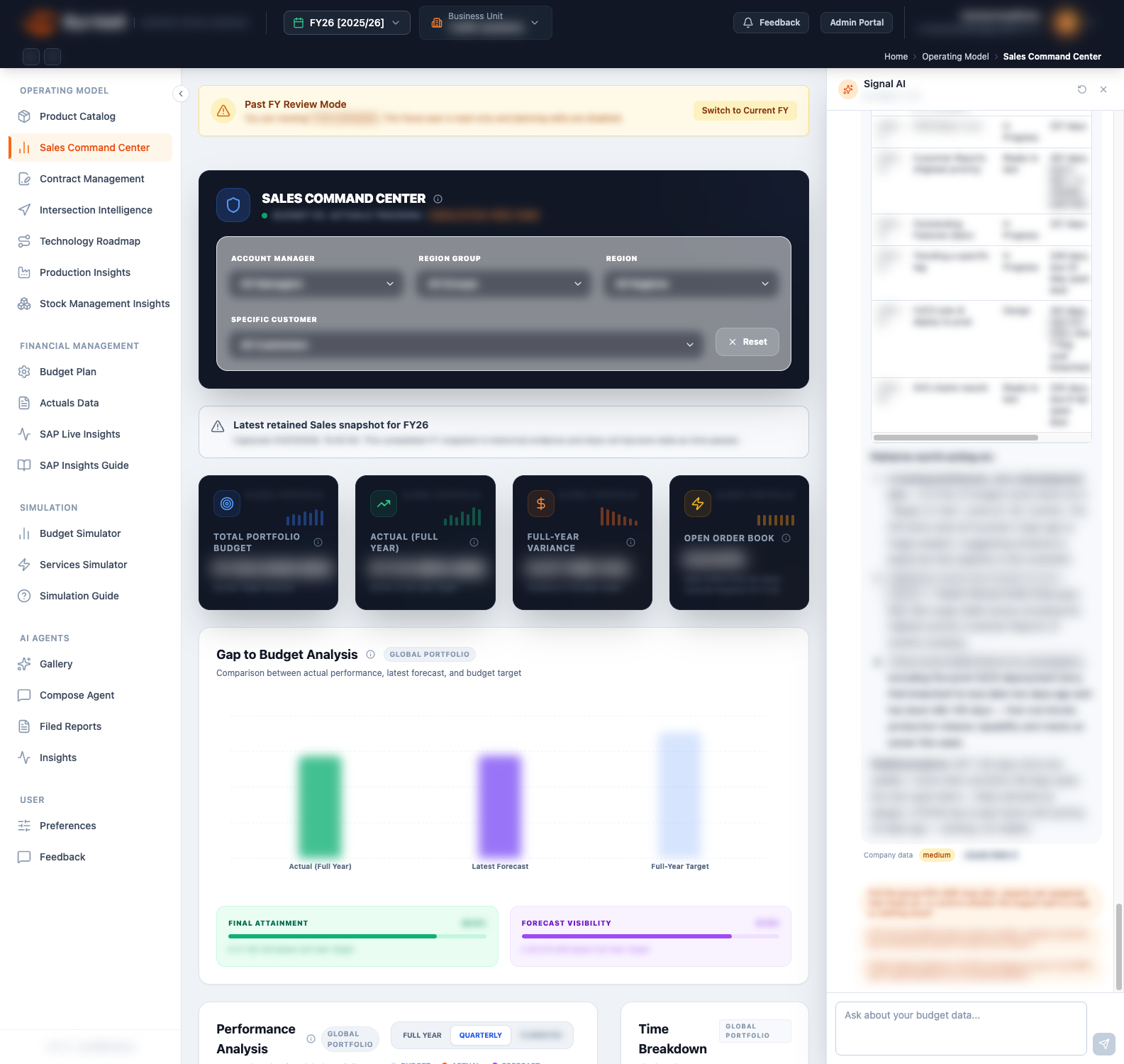
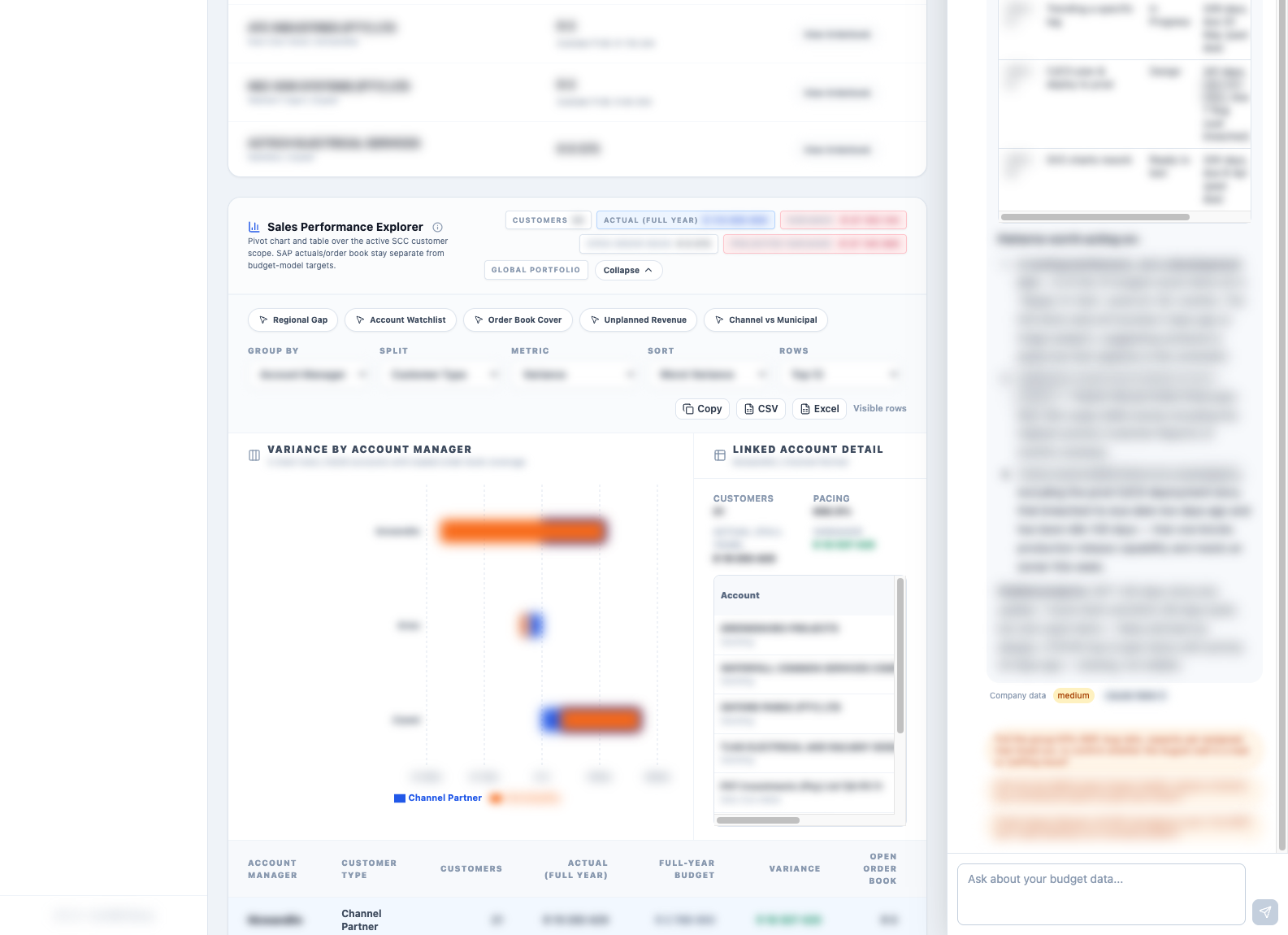
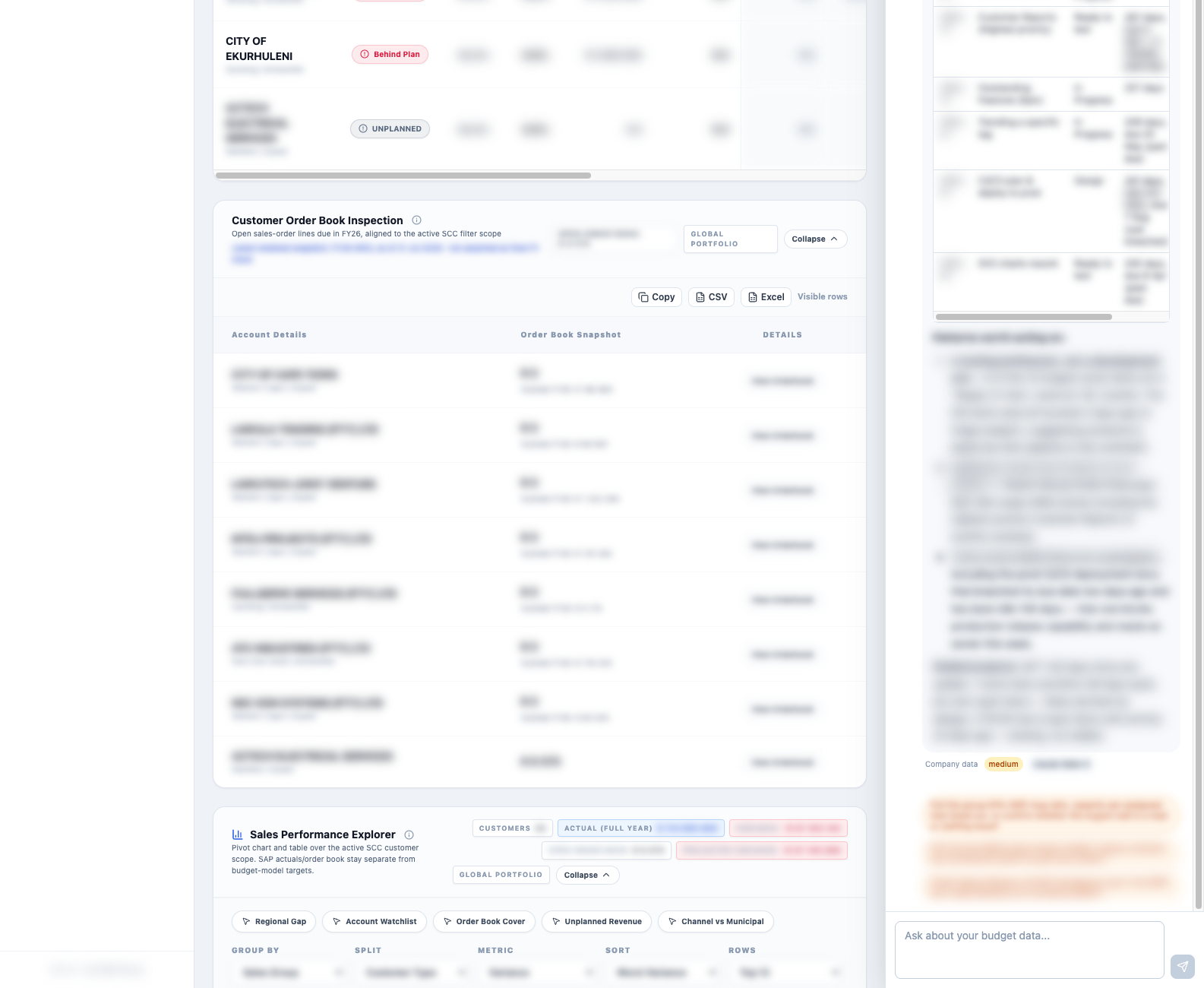
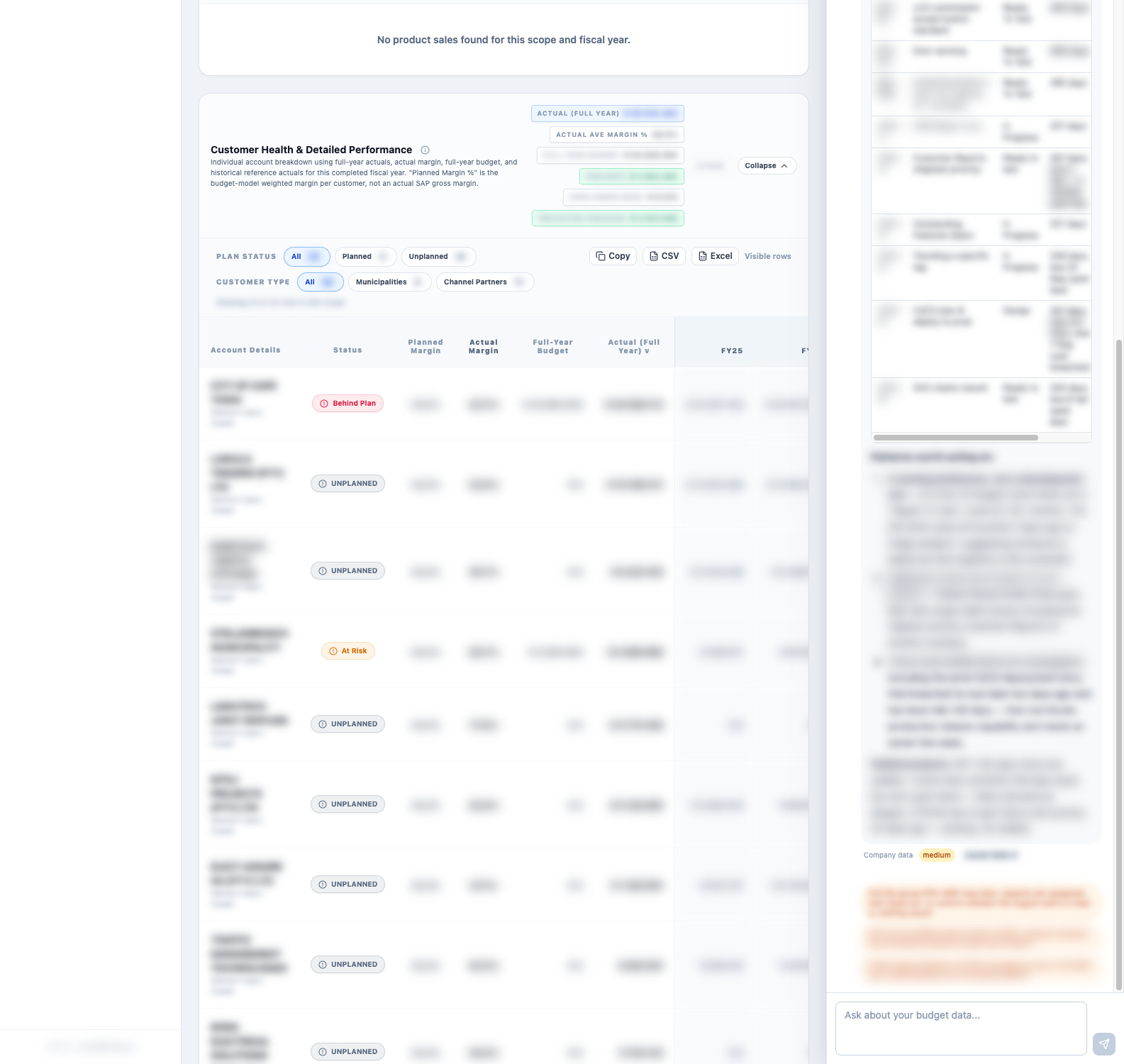
Portfolio → customer → order line. Three levels, one surface, one permission model.
The SAP bridge
Start with the export, not the API
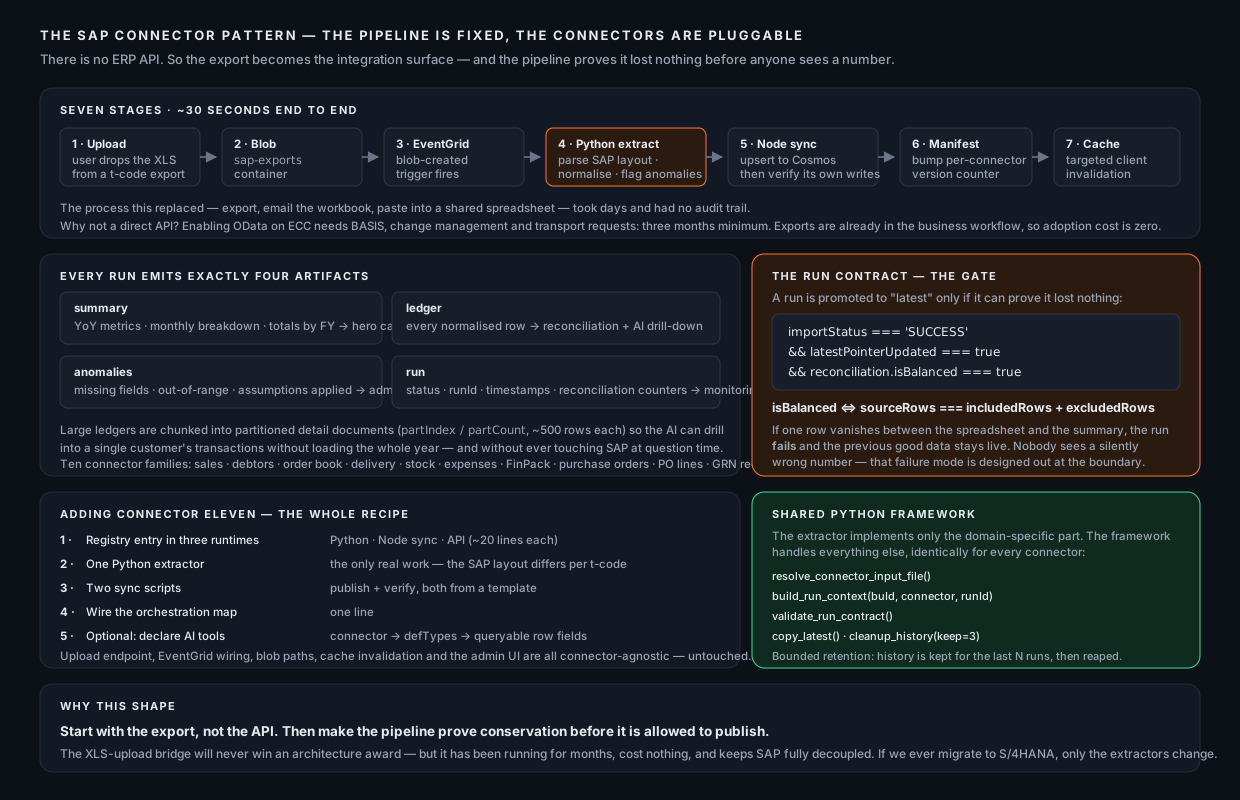
No-loss reconciliation
importStatus            === 'SUCCESS'
&& latestPointerUpdated === true
&& reconciliation.isBalanced === true
//  sourceRows === includedRows + excludedRows
If it balances
Promote to latest · bump the per-connector manifest · invalidate exactly the affected client caches.If one row vanished
The run fails. The previous good data stays live. Nobody sees a silently wrong number.Silent data loss is the failure mode that destroys trust in a finance tool — so it's designed out at the pipeline boundary, not checked for afterwards.
Separate freshness signalling from data transfer
Naive
Re-read all SAP data on every page load, for every user, forever — for data that changes once a week.What we do
Poll a tiny manifest every ~60s. Cache payloads for days. Refetch only when a per-connector version moves — a weekly stock ETL no longer invalidates the monthly FinPack cache.Encrypted client cache
AES-GCM · per-surface keys · gzip-before-encrypt · operator-controlled key rotation · fail-closed if WebCrypto or the key fetch is unavailable.No plaintext financial data reaches localStorage.
Result
Single-digit monthly Cosmos spend on a system carrying a decade of fiscal history.The AI engine
Tools, not retrieval
This is not a document-search problem.
It's a database-query problem.
Retrieval is probabilistic. Its failure mode is a confident answer derived from
approximately the right rows —
indistinguishable from a correct one until someone checks.
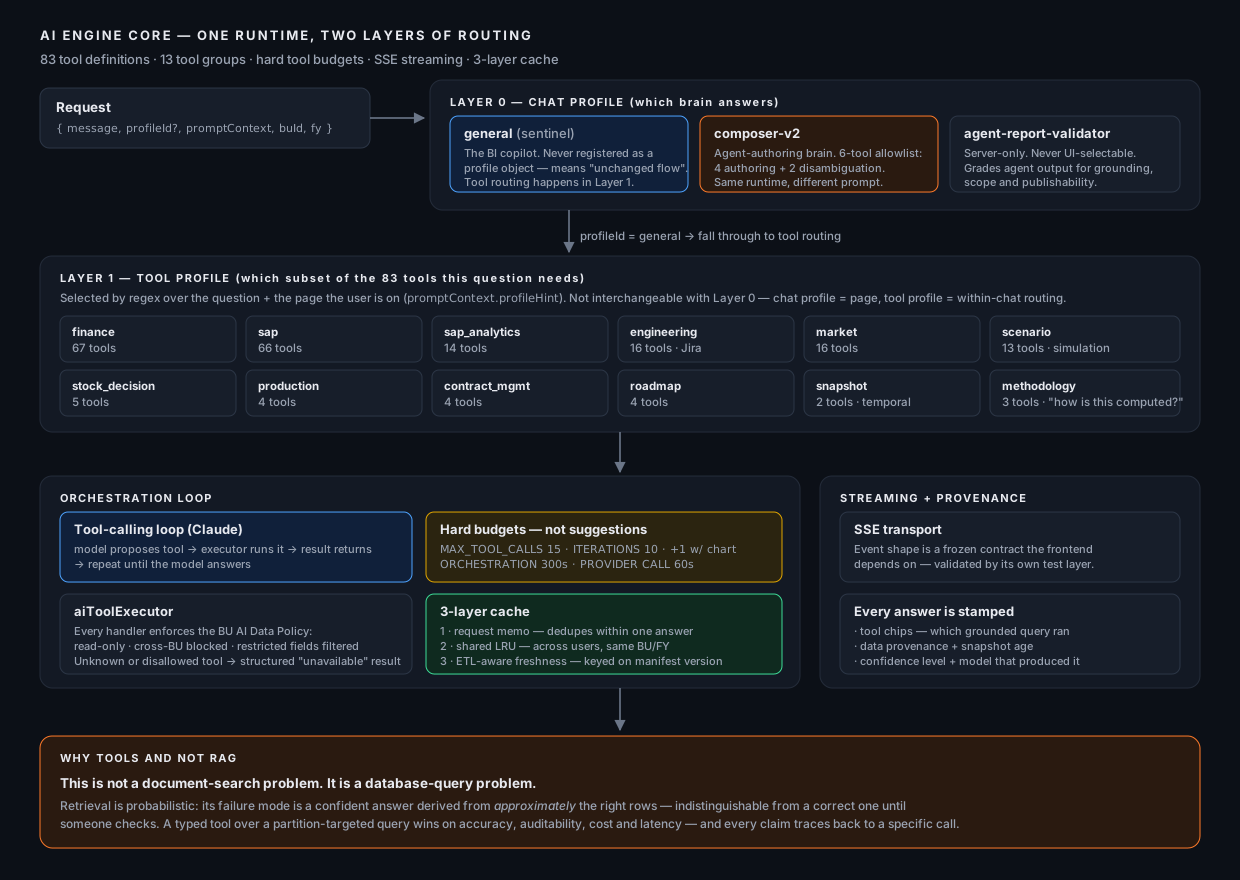
83 tools, routed by question and page
| Tool group | Tools | Answers questions like |
|---|---|---|
| finance | 67 | plan vs actual, PBT gap, margin analysis, fiscal-year comparison |
| sap | 66 | debtors risk, delivery performance, customer concentration, YoY |
| engineering | 16 | Jira throughput, stuck items, project health |
| market | 16 | competitor dominance, coverage gaps, installed base |
| scenario | 13 | what-if simulation, services model, goal seek |
| stock_decision | 5 | available-to-build, orderbook coverage, material 360 |
| production · contract · roadmap | 4 ea | repair jobs, contract 360, roadmap delivery |
| methodology | 3 | "how exactly is this computed?" — the trust tools |
Organised by business domain, not storage layout, so a user's question maps onto a tool without the model inventing a join.
I drove it as an executive would. Prose blurred; structure and provenance are not.
Structure, not fluency
Asked where gross margin was eroding, the copilot produced, in this order:
- Provenance first. Named the retained FY26-W53 snapshot, noted the data was 8 days old, and disclaimed it was not the final fiscal-year-close position.
- Contradicted the premise. "Your overall gross margin is not eroding — but three pockets are."
- Decomposed the erosion by product category with the rate change on each.
- Line-level evidence — part numbers showing cost bookings against zero revenue.
- Tabulated the customers driving the drag, ranked by GP impact.
- Proposed a causal hypothesis — tender pricing on a volume ramp — flagged as a hypothesis.
None of that is prompt politeness. It falls out of tools returning typed, timestamped, scope-filtered payloads. The model does synthesis, which LLMs are good at, over deterministic retrieval and arithmetic, which they are not.
170 insight definitions — the platform's own dictionary
Every metric on every dashboard has a catalog entry, and the AI has tools to read it:
get_insight_definition, search_insights.
The instruction that matters
The grounding tells the model that catalog formulas and assumptions beat general finance knowledge.Asked "how is margin calculated here", it answers from this platform's definition — not from what margin usually means.
Why this is the difference
An assistant that knows finance is a search engine with manners.An assistant that knows your finance can be argued with — and corrected — because its definitions are inspectable artefacts rather than model priors.
The clarification gate — deterministic, not prompted
| Resolver outcome | Action |
|---|---|
| not resolved | clarify — stop and ask |
| resolved, confidence < 0.70 | clarify — catches all-token guesses |
| resolved, 0.70 – 0.90 | echo — proceed, but say "reading X as Y — correct me" |
| resolved, ≥ 0.90 | answer — proceed silently |
When ambiguous, the handler returns a slim payload, candidates only, no data.
The system prompt already said "if ambiguous, ASK", and the model still guessed and proceeded. You cannot make the model ask by instructing it harder; you make answering impossible without asking by withholding the data.
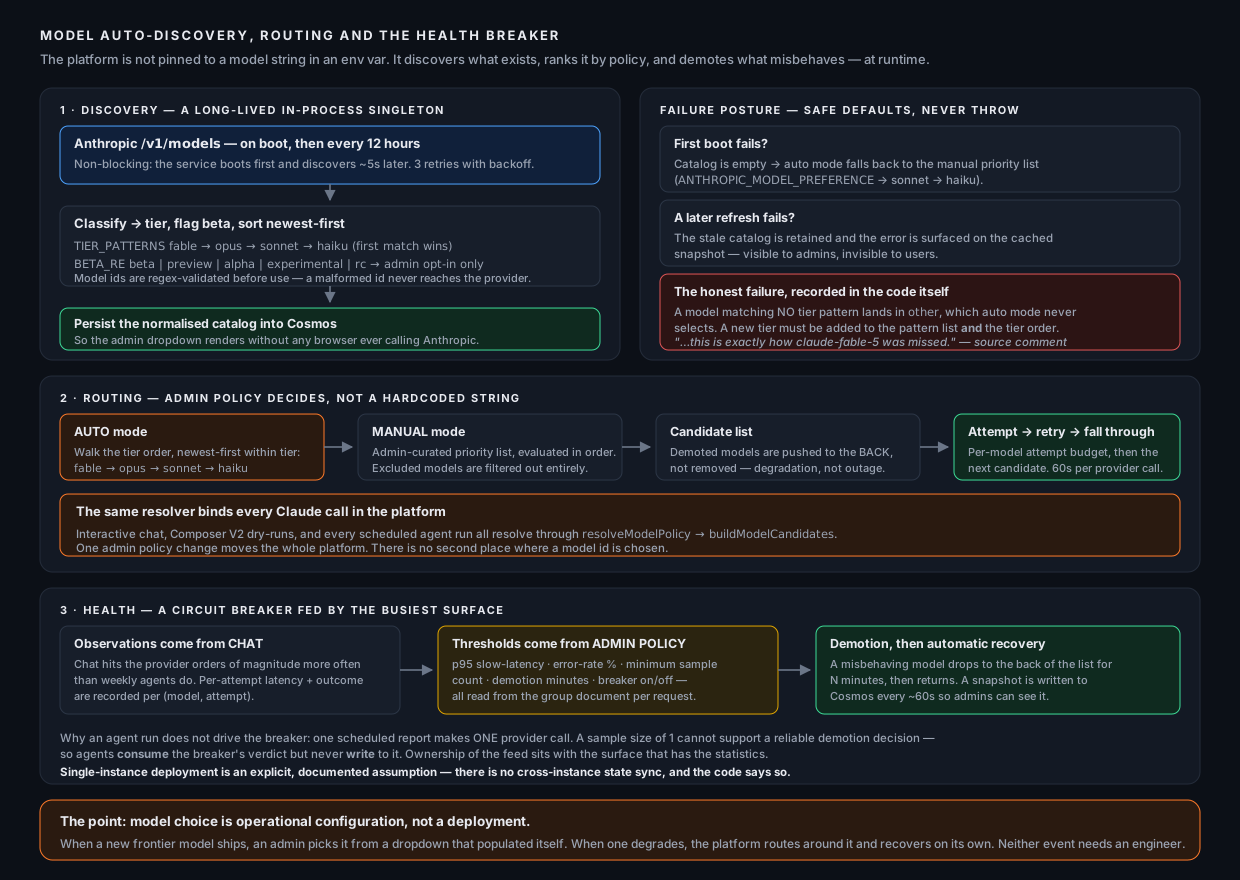
Model choice is operational configuration, not a deployment.
A new frontier model ships → an admin picks it from a dropdown that populated itself.
One degrades → the platform routes around it and recovers on its own.
Neither event needs an engineer.
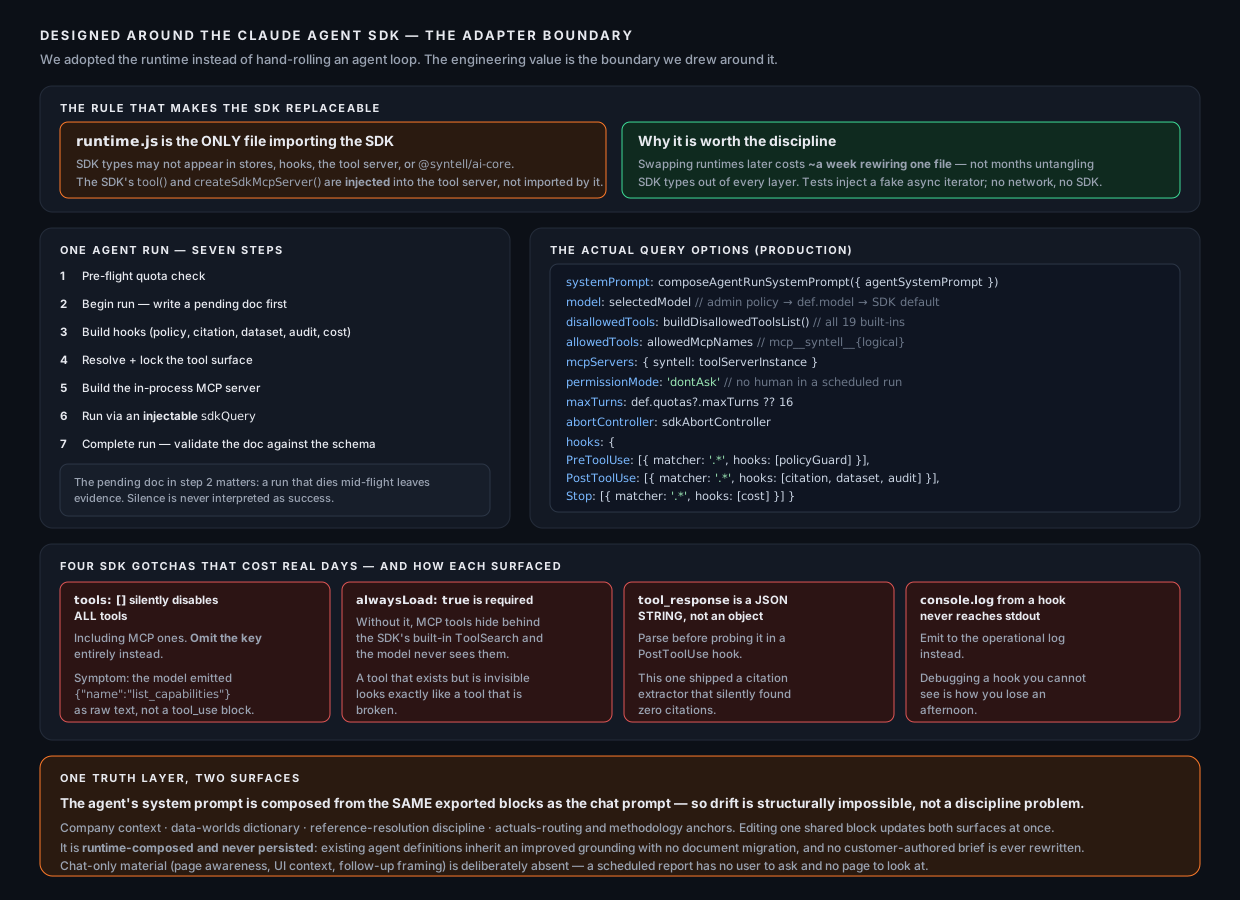
One truth layer, two surfaces
The agent's system prompt is composed from the same exported blocks as the chat prompt: company context · data-worlds dictionary · reference-resolution discipline · actuals-routing and methodology anchors.
Editing one shared block updates both surfaces at once. Drift is structurally impossible, not a discipline problem.
Runtime-composed and never persisted: existing agent definitions inherit an improved grounding with no document migration, and no customer-authored brief is ever rewritten.
Two of the eight agent conduct rules
NAMES, NOT IDS. Never surface raw SAP customer numbers or internal keys in narrative. Resolve to friendly names — or say explicitly that you couldn't.FRESHNESS IS PART OF THE TRUTH. State "Data as of <date>" from tool metadata, and flag any source older than seven days as stale.
What's deliberately absent
Page awareness, UI context, follow-up framing — a scheduled report has no user to ask and no page to look at.The agent platform
Chat answers the question you thought to ask.
Agents answer the ones you should be asking.
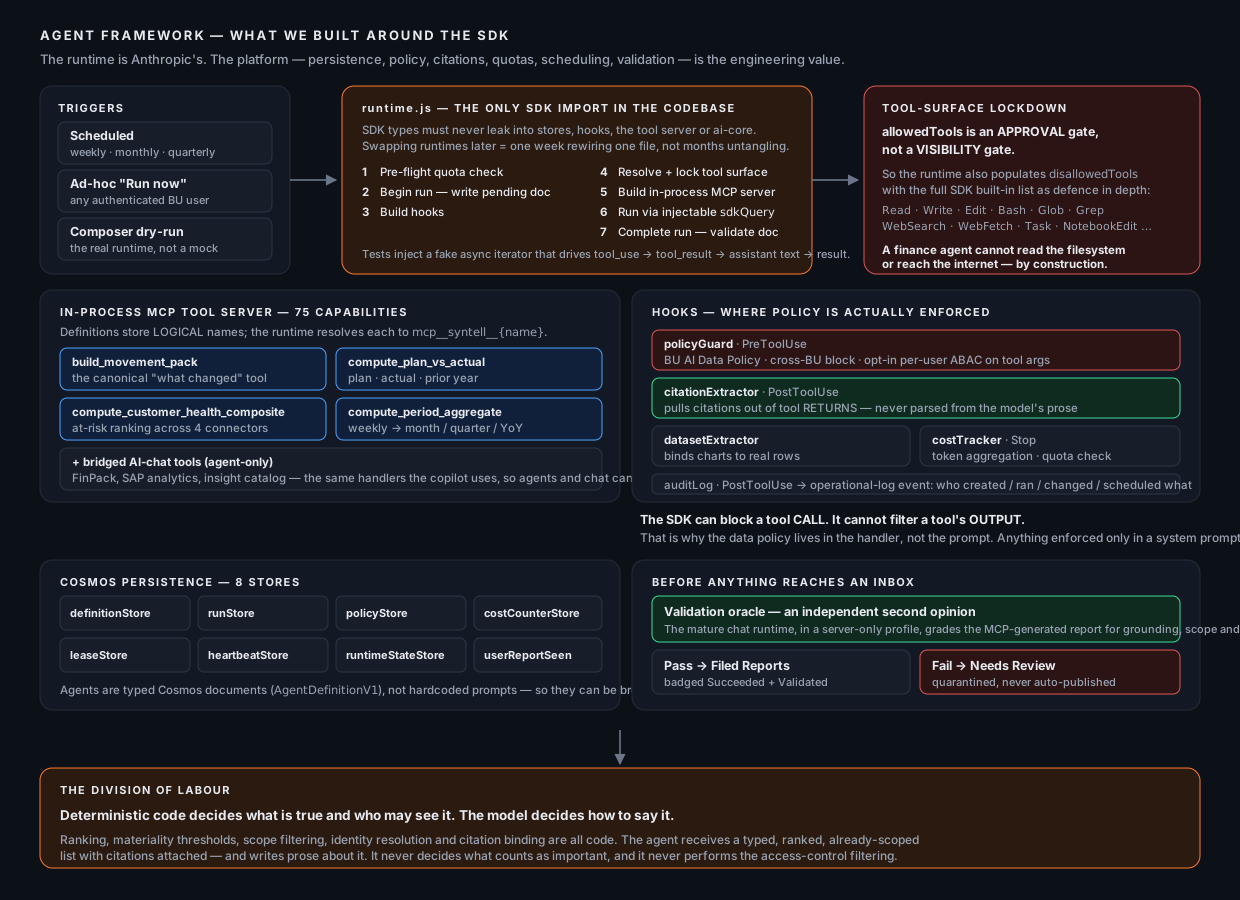
Five decisions that make agents safe
1 · Quarantine the SDK
runtime.js is the only file importing the Agent SDK. Types may not leak into
stores, hooks or ai-core. Swapping runtimes = one week, one file.2 · Lock the built-in tool surface
allowedTools is an approval gate, not a visibility gate — so we also populate
disallowedTools with every SDK built-in, and reject definitions that smuggle one in.3 · Enforce policy in the handler
The SDK can block a tool call; it cannot filter a tool's output. BU data policy, cross-BU block and opt-in ABAC live in the handlers.4 · Extract citations structurally
A PostToolUse hook pulls citations out of tool returns into the run document — never parsed from the model's prose.5 · Validate before publishable
An independent oracle grades every generated report for grounding, scope and publishability in strict JSON. Failures land in a Needs Review queue, not an inbox.Plus
Per-BU and per-agent cost quotas, and an audit hook recording who created, ran, changed or scheduled what.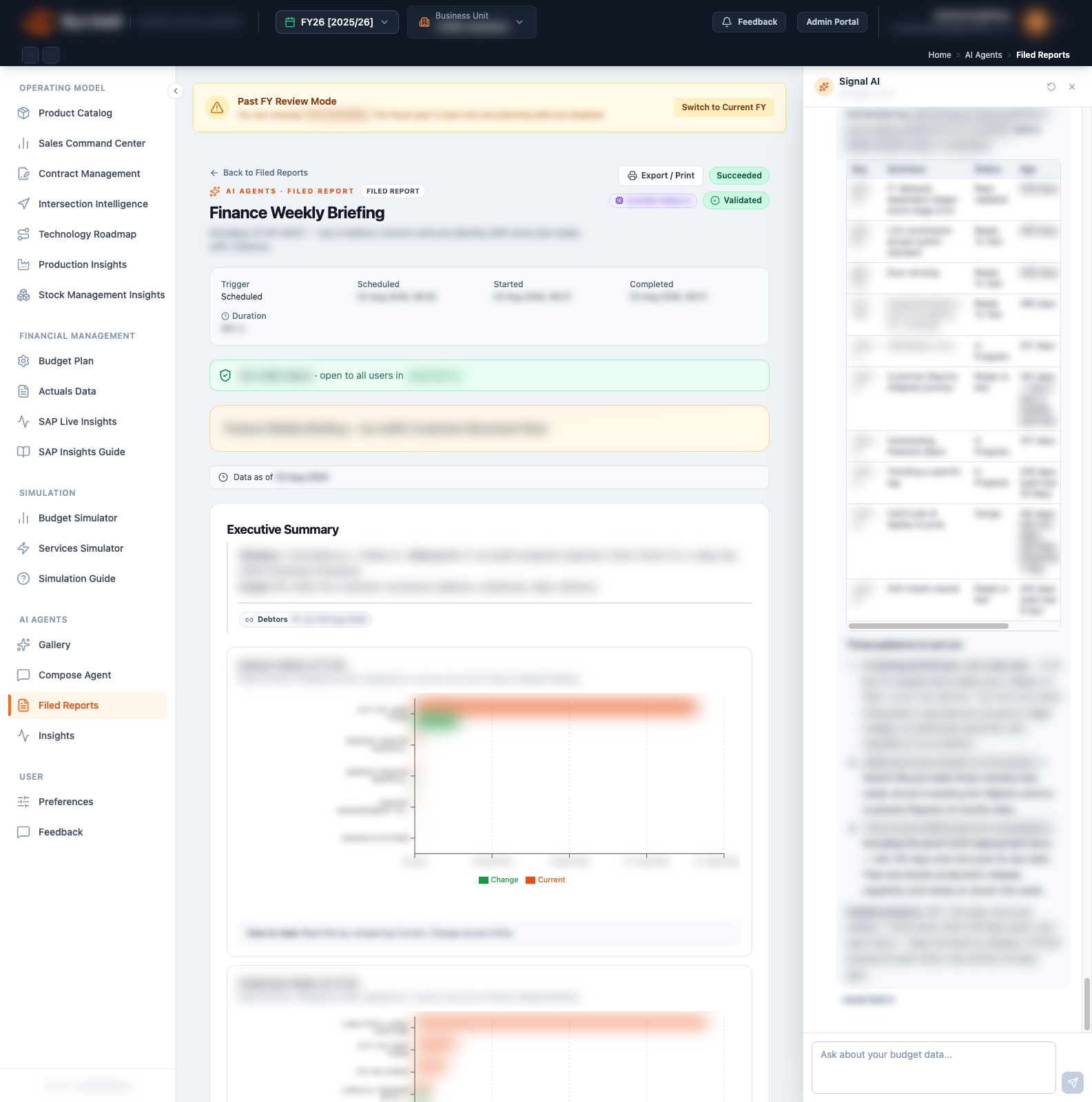
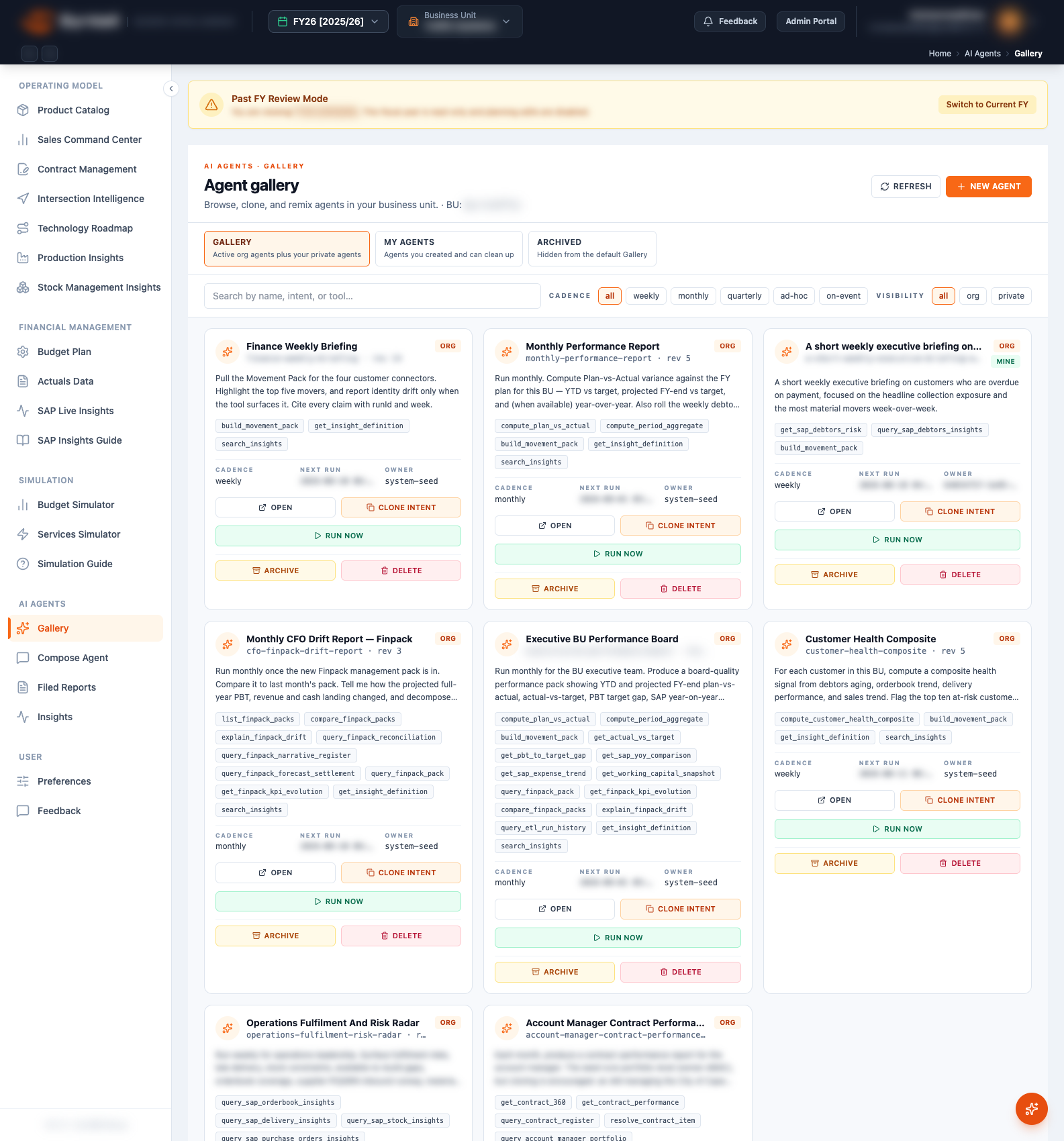
This ran at 08:00 without anyone pressing a button.
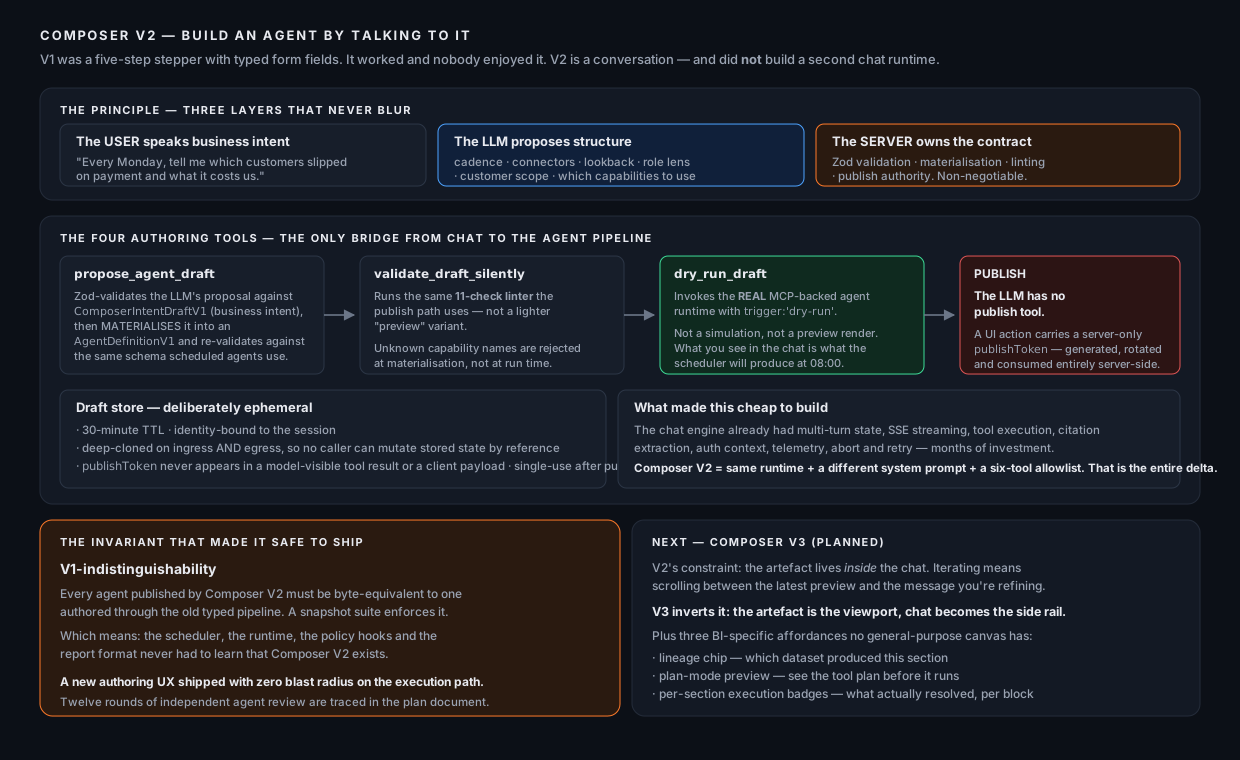
V1-indistinguishability
Every agent published by Composer V2 must be byte-equivalent to one authored through the old typed pipeline. A snapshot suite enforces it on every PR.
Which means the scheduler, the runtime, the policy hooks and the report format never had to learn that Composer V2 exists.
A new authoring UX shipped with zero blast radius on the execution path.
How to get invariants like this
Twelve rounds of independent adversarial agent review are traced in the plan document before a line was written.The review didn't just find bugs — it deleted features. A parallel chat runtime, a marker protocol, a separate MCP factory map: all proposed, all cut.
Governance
The part that took longest and demos worst
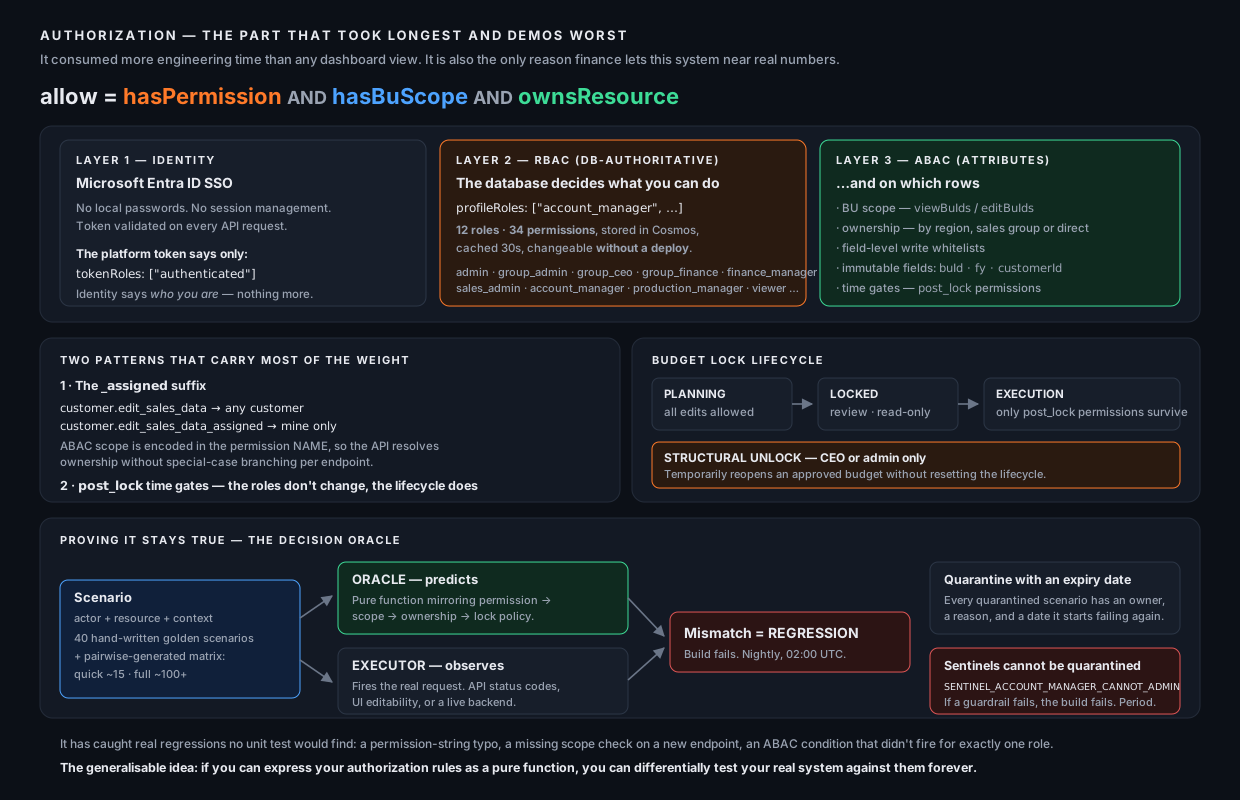
"Enterprise grade" is mostly this, the unglamorous half
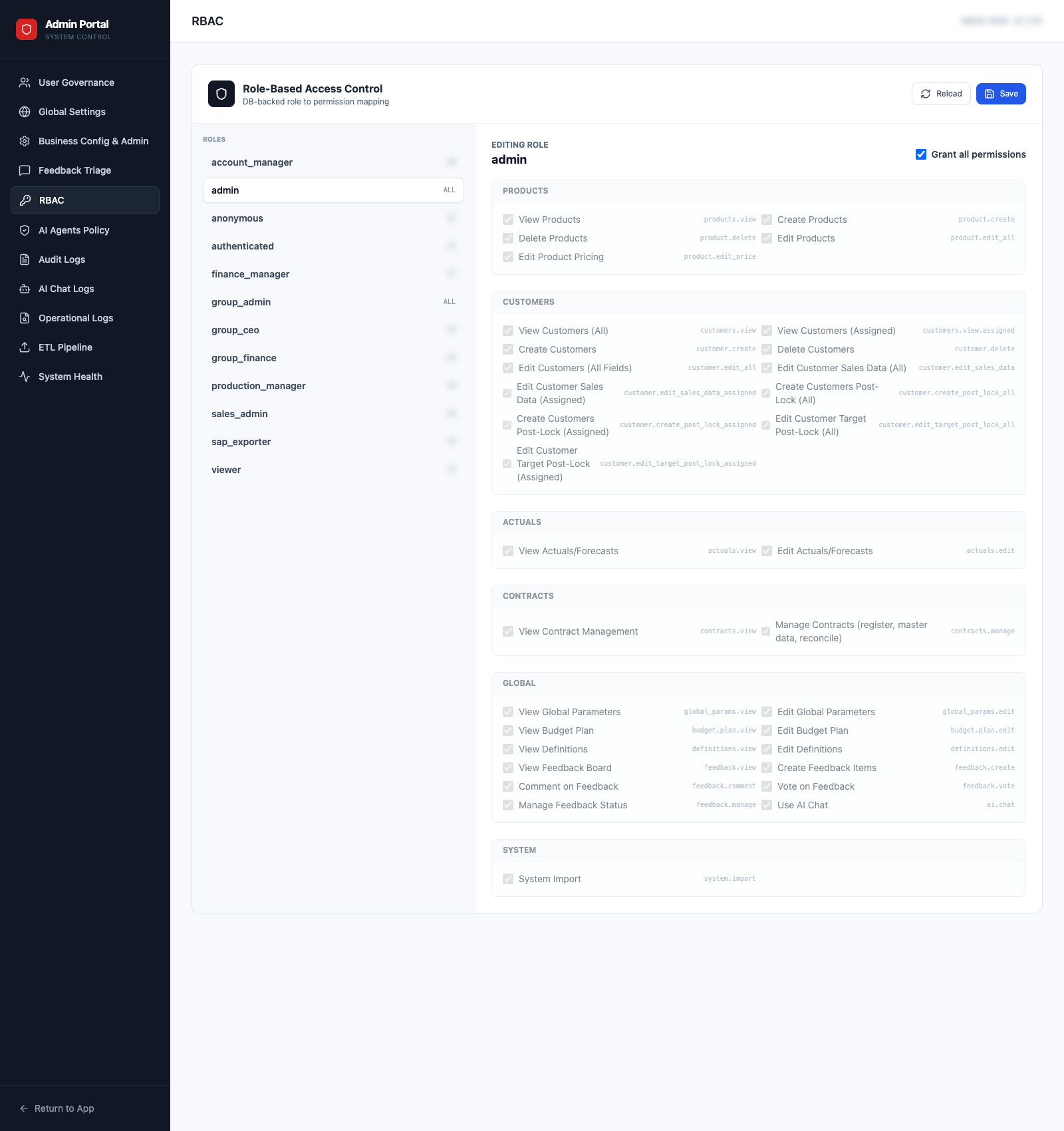
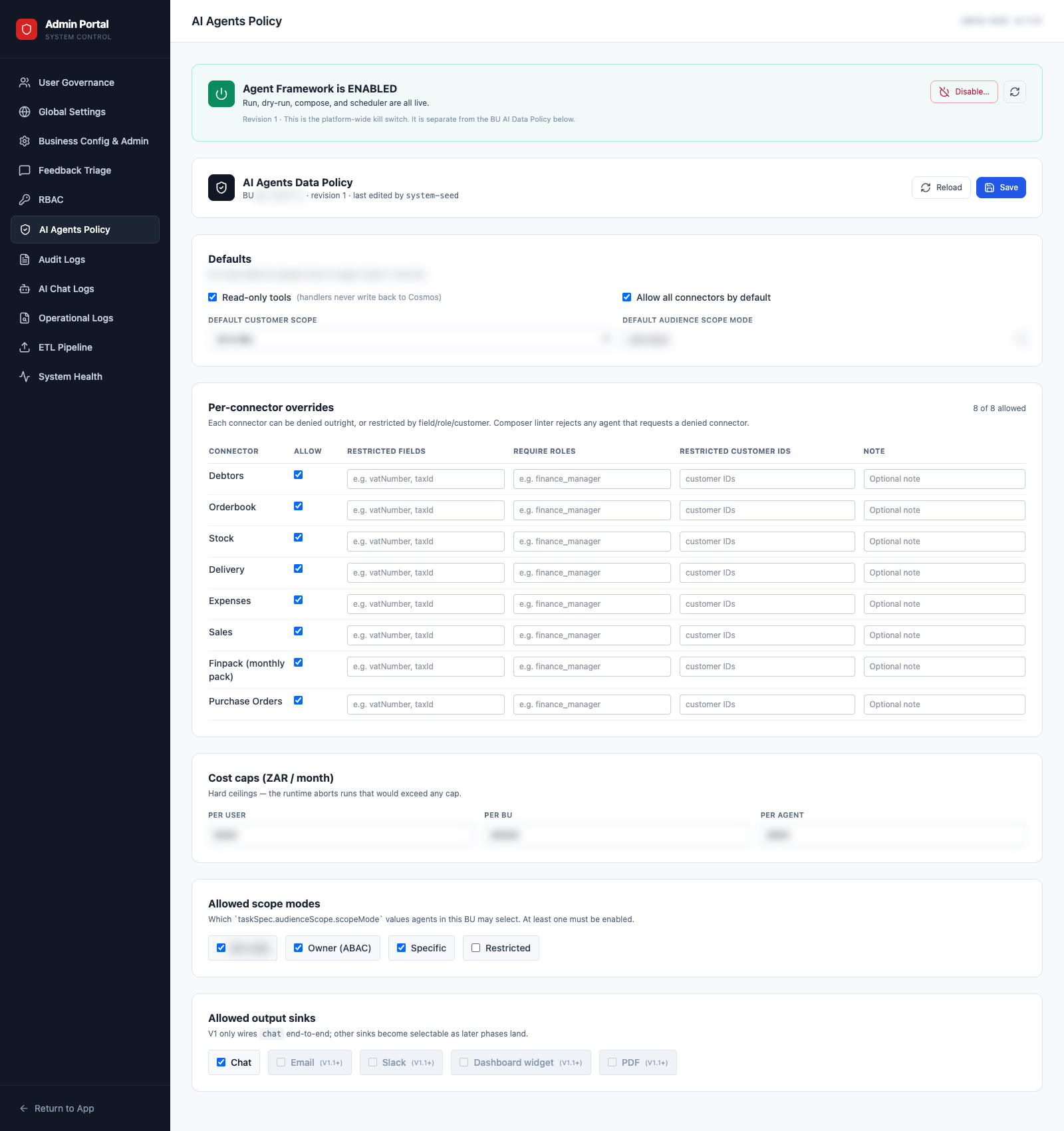
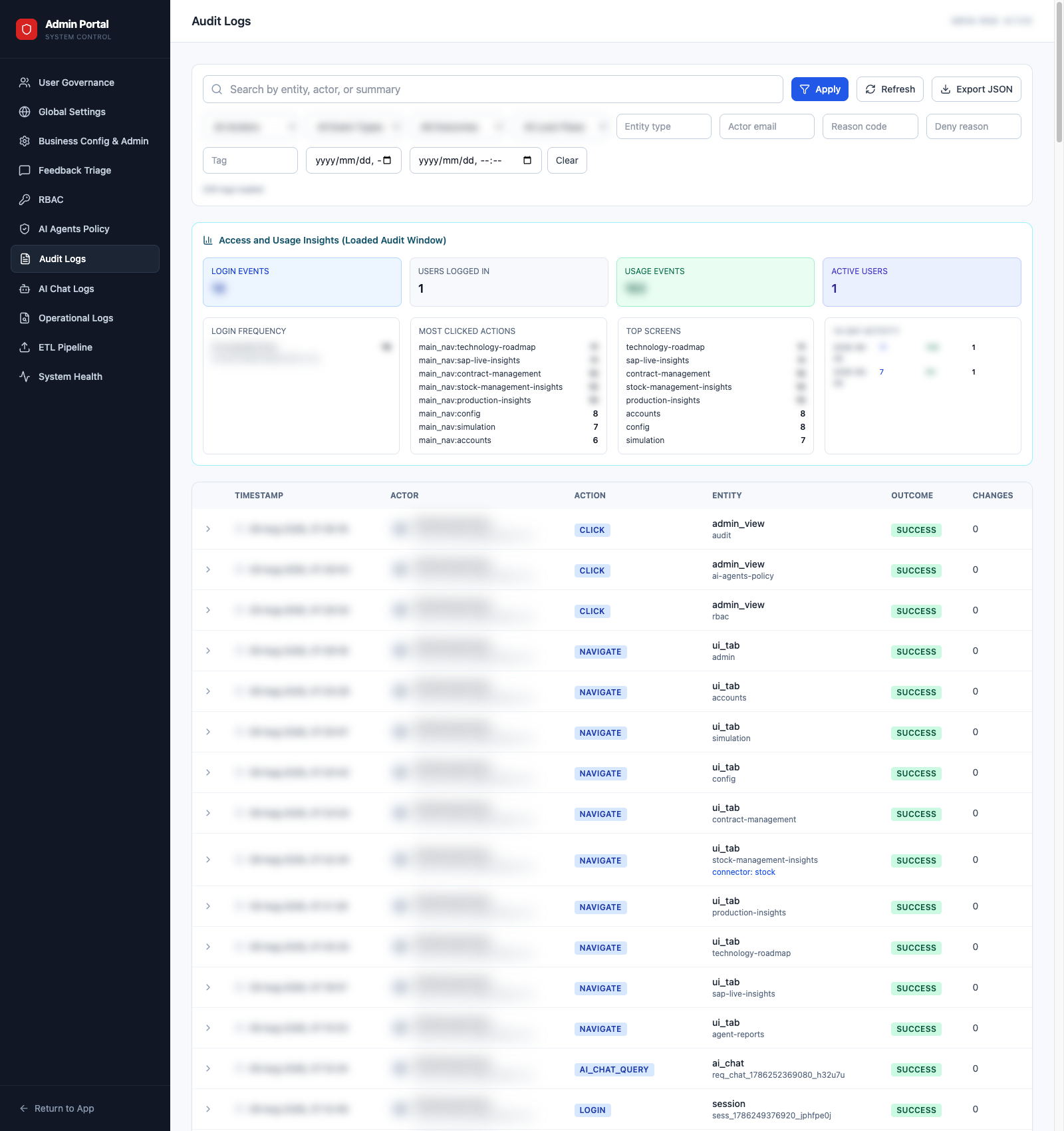
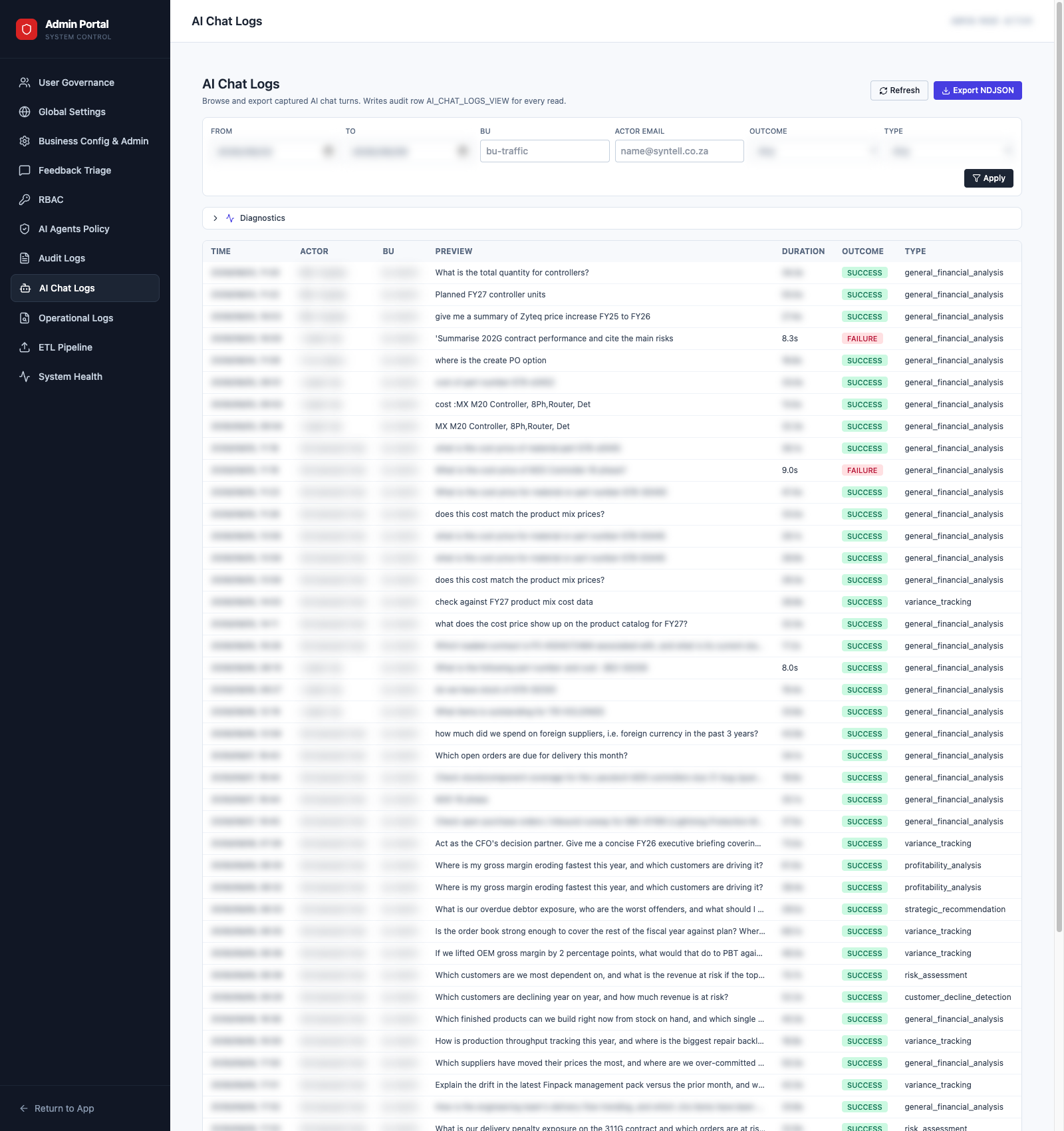
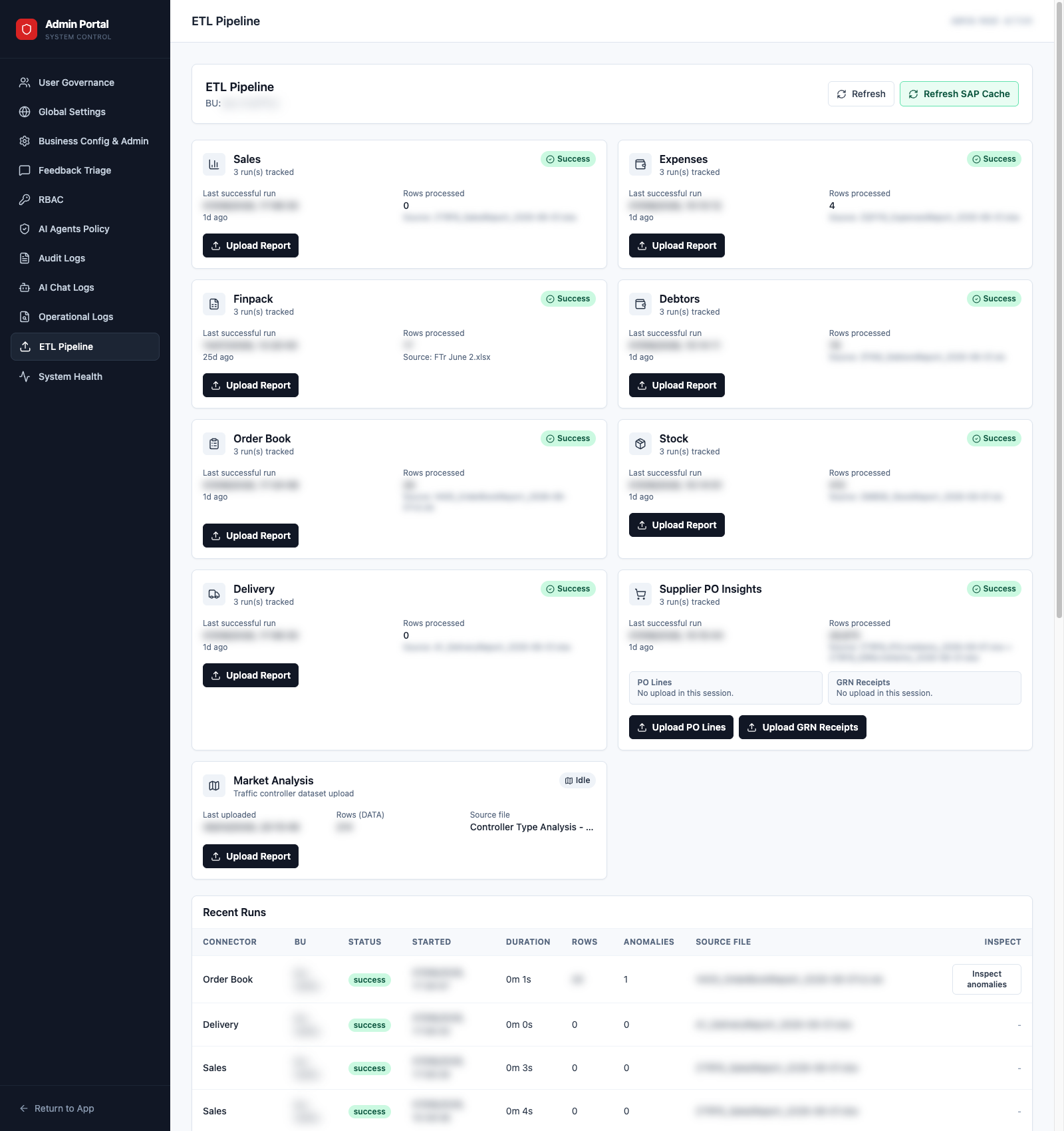
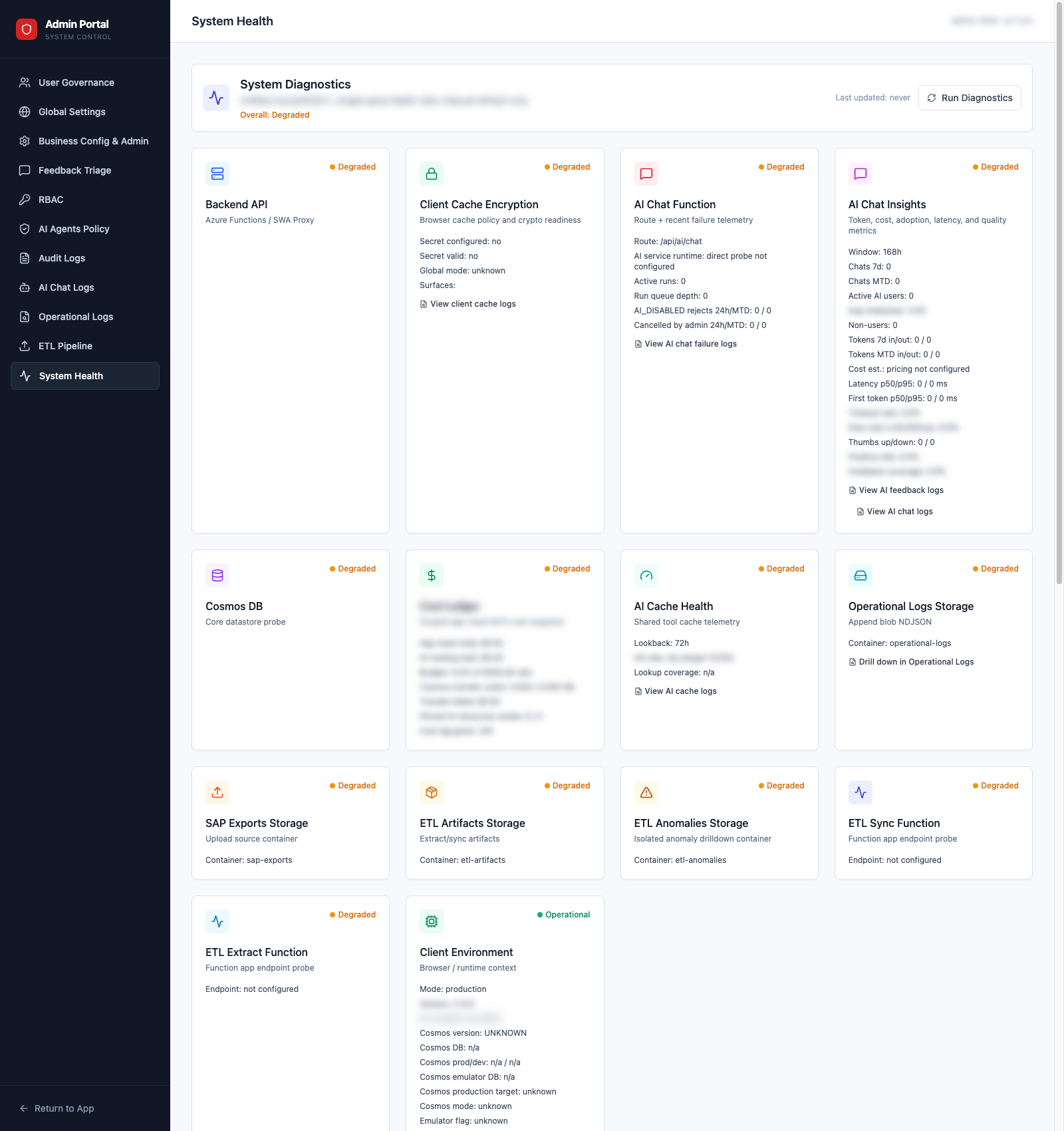
Full set: User Governance · Global Settings · Business Config & Admin · Feedback Triage · RBAC · AI Agents Policy · Audit Logs · AI Chat Logs · Operational Logs · ETL Pipeline · System Health
455 test files across five layers
| Layer | What it protects |
|---|---|
| Domain model | The pure financial engine — margin, discount compounding, freight modes, break-even, projection |
| API contract | Request shape → response shape; permission gate → HTTP status. Named *.contract.test.js because they encode contracts other systems depend on |
| Frontend component | Not pixels — logic. Does the ETL tab appear for sap_exporter? Does the lock banner render when the FY is locked? |
| Authorization harness | Oracle vs. executor, golden + pairwise matrix, quarantine with expiry. Nightly at 02:00 UTC |
| AI service | ai-core contracts, extraction, and SSE event-shape validation — the stream format is a contract the frontend depends on |
I did not write these because I'm disciplined. I wrote them because of the next slide.
Every contract clause has a scar behind it
| What happened | What it became |
|---|---|
| An AI agent "simplified" a component and silently deleted 200 lines | NEVER OMIT CODE — in the agent contract, in capitals |
| One ESM import crossing a function-folder boundary crashed the entire Functions worker — not one endpoint, all of them | runtime-boundary.contract.test.js |
| Months later: contract code imported a workspace package that resolved in the monorepo but was absent from the deployed package | Byte-parity mirroring + guard extended to reject deploy-absent imports |
| Eight formula bugs in one day, each producing plausible-looking numbers | financialModel.js became a protected file |
| Different scripts used different partition-key paths for the same containers | One path (/pk) everywhere; one config file as sole source of truth |
Source resolution is not package resolution. The exact deployment artifact must load against only its own production dependency graph before it ships.
AgentDefinitionV1 has no enabled field.
The predicate never matched. No scheduled agent run could ever fire.
The weekly briefing was scheduled. The system reported no errors. Nothing happened.
There is no exception to catch when your filter silently matches nothing.
Freeze the deploy graph
- Deploys install the exact graph CI validated —
npm ciagainst a committed lockfile - Any version move shows up as a reviewable lockfile diff in a PR, not invisibly at deploy time
- Four surfaces — web host,
api,ai-service, ETL Python — are separate deploy units, never co-mingled
The guiding principles, verbatim
Pin what works; don't chase latest.Subtraction beats migration — removing an unused dependency shrinks the audit surface with zero functional risk.
One surface, one wave, one PR.
That is the core defence against slopsquatting and surprise upgrades.
What I got wrong
A self-assessment that only lists strengths isn't one
Level 3 of 5
| Dimension | Now | Target |
|---|---|---|
| Grounding & provenance | 4 | 4 |
| Tool use & capability management | 4 | 4 |
| Human-in-the-loop & clarification | 4 | 4 |
| Agent runtime & execution model | 3 | 4 |
| Model orchestration & reliability | 3 | 4 |
| Guardrails, safety & governance | 3 | 4 |
| Evaluation (agent output quality) | 2 | 4 |
| Observability & telemetry | 2 | 4 |
| Business context & memory | 2 | 4 |
| Multi-agent & durable workflows | 2 | 3 |
How it was produced
A multi-agent workflow mapped 12 AI subsystems against ~60 primary sources on the 2025–26 state of the art — then adversarially verified every claimed gap back against the codebase.13 of 26 gap-claims turned out to be overstated. The code already had a partial implementation, or the "gap" was a deliberate documented decision.
The sharpest criticism in it
A recurring "documented-but-not-enforced" risk. Several controls are described in contracts but not mechanically verified.Writing the rule is the easy half.
3–4 on the hard, differentiating dimensions.
2 on the operational hygiene the industry standardised in 2025.
Most enterprise teams are the mirror image:
decent ops tooling bolted onto shallow grounding.
What's next
Near — close the hygiene gap
· Agent-output evals. World-class contract tests, zero quality evals. Golden questions, scored grounding + citation coverage, in CI.· OpenTelemetry
gen_ai.* spans. Bespoke correlation logging works; it doesn't interop.· Durable execution for the interactive chat loop.
· Turn declared controls into enforced ones.
Medium — product
· Composer V3. Invert the canvas: artefact as viewport, chat as side rail. Plus a lineage chip, plan-mode preview and per-section execution badges.· Material Cost Service. A cost needs an auditable basis, effective date, coverage and evidence — not just a number.
· Stock beyond
gross_buildable — reservation-aware free stock.· A memory layer. There is none today.
Long — the big one
Intersection Intelligence. A map-first digital twin of every road junction in South Africa — signalised, roundabout, stop-controlled — with confidence scores and a proprietary overlay of deployed controller make/model.Replaces municipality-level market analysis (aggregate, stale) with intersection-level reality (spatial, refreshable).
86 locked design decisions.
The most ambitious thing on the roadmap was designed, from the first line, to be switchable off.
Intersection Intelligence ships as a standalone Fastify service on its own App Service plan, mirroring the AI service, because, in the owner's words: "if it does not work, it should be switched off without breaking the core of the app."
A kill-switch ladder, its own operator console, and a proxy line in the host that can simply stop resolving.
The trust machinery worked. The engineering had a hole.
What happened
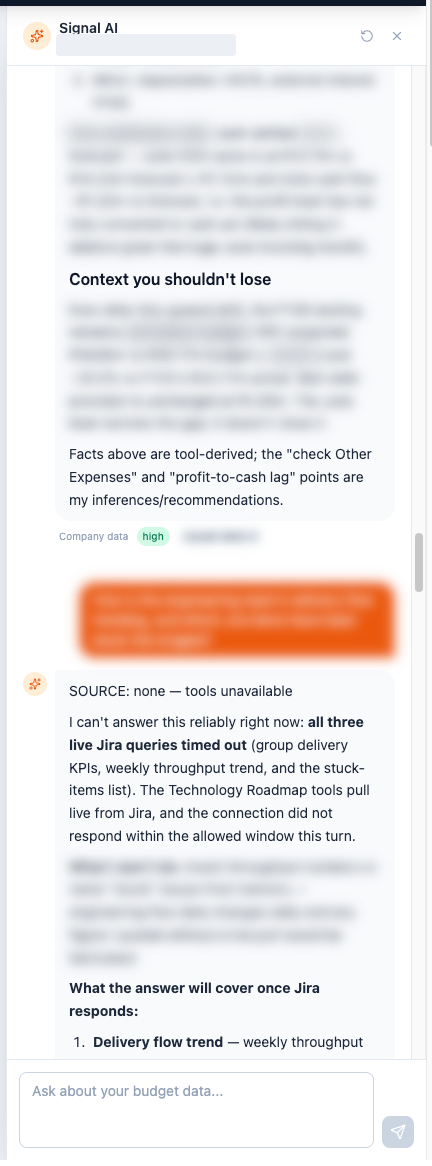
I re-ran the Jira question for this edition. The tools timed out again — three attempts out of three.This time it degraded better: it fell back to the Roadmap page KPIs (same live Jira data, already in Cosmos), gave a real quantified answer on throughput and WIP, and refused only the part it couldn't source.
"22 items have been stuck for more than 90 days. I attempted to pull the ranked list but the Jira query timed out this turn — I don't have the individual items, so I won't guess at which ones are oldest."
Root cause
TOOL_TIMEOUT_MS = 5000 is the default tool budget.Production tools were recognised as slow and given a 30s override. No Jira tool was ever added to that map — so a cross-internet call to Atlassian Cloud gets the same five seconds as an in-region Cosmos point read.
The fix isn't a bigger number
Derive the timeout from a declaredexecutionClass on each tool, and add a contract
test asserting every tool making an outbound non-Azure call is declared
external-api.That turns a silent 5s default into a build failure.
Beware the opt-in registry.
Two of this platform's real bugs are the same shape:
The missed model tier
A model matching no tier pattern lands inother — and auto mode never selects it.
"…this is exactly how claude-fable-5 was missed."The Jira timeout
A tool absent from the override map silently inherits a 5s budget meant for in-region reads.Derive from a declared property; test the derivation. A map that new items must be added to will eventually not be.
What building this
actually taught me
Evidence, not adjectives
Not "I know about AI agents"
I have made every architectural decision that determines whether an enterprise agent platform is trustworthy, and I can show you the specific incident that taught me each one.
What a CV usually claims
"Led AI initiatives" · "delivered a GenAI pilot" · "familiar with RAG and agents".Exposure. Cheap in 2026.
What this is instead
A production system with named failure modes, a published maturity score, and a bug report I wrote about my own platform three slides ago.Ten things this platform is evidence of
| Competency | The evidence |
|---|---|
| AI strategy under constraint | Bridge around an un-migratable ERP instead of a seven-figure programme; single-digit monthly DB cost |
| Knowing when not to use the fashionable pattern | Refused RAG for numbers; cut a sub-agent swarm, a custom DSL, a parallel data plane and a second chat runtime |
| Grounding & the economics of trust | Structural citation extraction; provenance + confidence + model on every answer; it refuses when tools fail |
| Agentic architecture & vendor risk | One file imports the SDK; swap cost stated as ~1 week; four SDK gotchas known from being cut by them |
| Model portfolio management | Auto-discovery, tier policy, health circuit breaker with demotion and recovery — one resolver for the whole platform |
| Governance that is enforced, not declared | Policy in tool handlers, not prompts; built-ins denied by construction; quotas, audit, validation oracle |
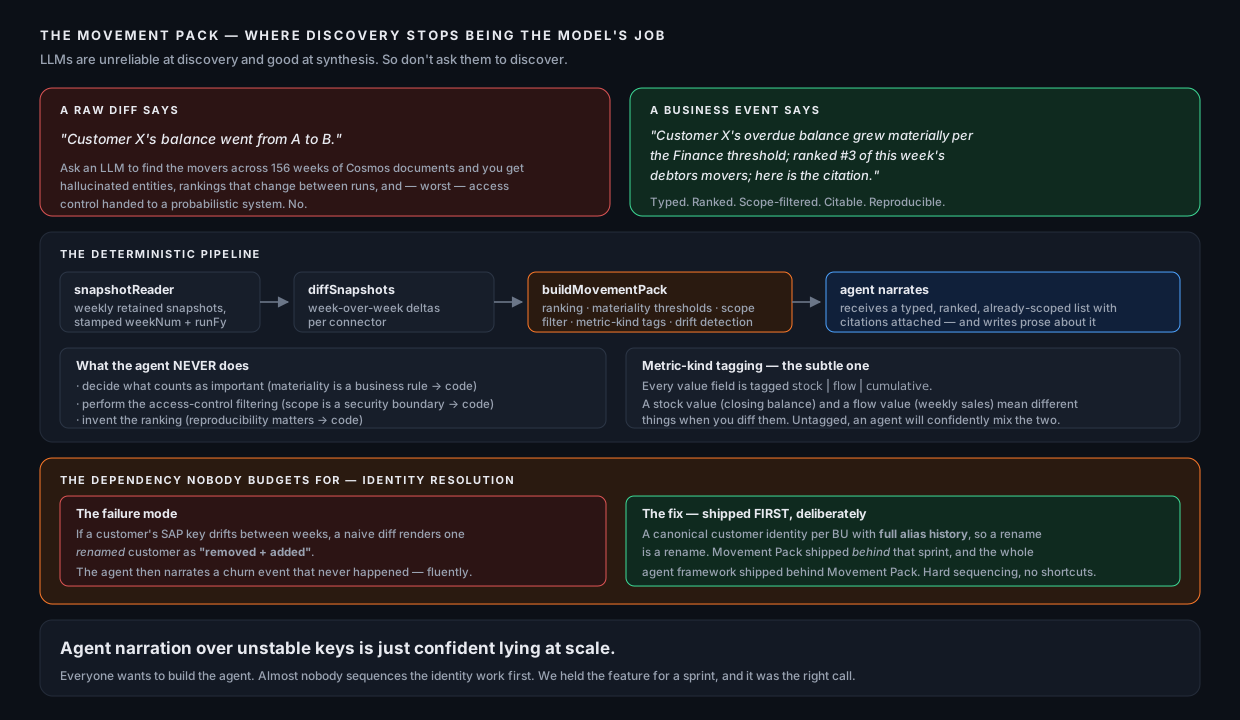
| Deterministic / probabilistic decomposition | Ranking, thresholds, scope and identity are code; identity resolution shipped before the agent feature |
| Evaluating your own programme honestly | Level 3/5 published with the 2s visible; 13 of 26 gap-claims adversarially disproved |
| AI-augmented delivery as an operating model | 1,184 commits solo; leverage came from contracts, not prompting; two-model pairing with human arbitration |
| Product judgement in an AI surface | The LLM has no publish tool; V1-indistinguishability let a new UX ship with zero blast radius |
I built and operate a production agentic platform over a legacy ERP: 83 typed tools, 75 agent capabilities, a scheduled agent framework on the Claude Agent SDK with policy enforced at the tool-handler boundary, structural citation extraction, an independent validation oracle, per-tenant cost quotas, model auto-discovery with a health circuit breaker, and a three-layer authorization model differentially tested by a decision oracle every night.
I can tell you which of those decisions were load-bearing, which were fashion, and which one I would sequence differently, because I have the incident behind each.
The competency map
Self-taught, self-rated, and deliberately not all fives
Where I actually am
gen_ai.*)2Every rating above is defended by a named artefact in this deck. The next slide shows the evidence for the fives — and why three of these are deliberately low.
Each rating maps to something in this deck
| Competency | What backs it |
|---|---|
| Prompt & system-prompt architecture | "One truth layer, two surfaces" — chat and agent prompts composed from shared blocks so drift is structurally impossible; 8 non-negotiable agent conduct rules |
| Tool / function-calling design | 83 typed tools across 13 groups, two-layer routing (chat profile / tool profile), hard budgets: 15 calls, 10 iterations, 300s ceiling |
| Conversational chat engine | Built from scratch: multi-turn, SSE streaming with a frozen event contract, 3-layer cache, abort/retry, deterministic clarification gate |
| Agent harness & orchestration | Scheduled agents in production: definitions as typed documents, scheduler, run store, citations, quotas, validation oracle, Needs-Review queue |
| Claude Agent SDK | One-file adapter boundary; disallowedTools defence in depth; PreToolUse/PostToolUse/Stop hooks; four SDK gotchas known from being cut by them |
| Grounding & provenance | Structural citation extraction from tool returns; snapshot-dated citation chips; provenance + confidence + model on every answer; it refuses when tools fail |
| Security & authorization for AI | 3-layer authz enforced in tool handlers, not prompts; 12 roles / 34 permissions; decision oracle differentially testing it nightly |
| Data engineering for AI | 10 SAP connectors with no-loss reconciliation; 170-entry insight catalog as a semantic layer the model reads |
| AI product design & explainability | Insight Explainer drawer (what / sources / how-calculated / "Ask AI About This"); confidence chips; clarification UX |
| AI-augmented software delivery | 1,184 commits solo in 8 months; contracts-not-prompts operating model; two-model pairing with human arbitration |
Why three of those are twos — and one is a one
Evals & output-quality measurement — 2
World-class contract tests; until recently zero quality evals. I built the hard part first and left the layer the industry standardised in 2025. It is the top item on my backlog, and the first thing I'd build at a new company.AI observability — 2
Solid bespoke correlation logging; no OpenTelemetrygen_ai.* spans, so it doesn't
interoperate with anything.RAG / vector retrieval — 2
I deliberately refused RAG for structured financial data and can defend that decision in detail — but I won't claim depth I don't have. If your problem is genuinely document search, hire someone with a 5 here.Fine-tuning / model training — 1
I have not trained or fine-tuned a model. My leverage has been architecture around frontier models, not producing them.A matrix with no low scores is a marketing document. These four are exactly what I'd want to be hired to go and close.
Everything on the previous slides is self-taught, built in production, against real money, and documented well enough that you can audit the claims.
Best fit
Head of AI · VP AI Engineering · AI Platform / Applied AI Architect · Chief AI Officer (mid-market) · CTO (mid-market)What I'd bring in month one
A benchmark of your AI estate against the current state of the art, with an evidence-cited, prioritised backlog — the same exercise I ran on my own platform, which disproved 13 of its own 26 findings."What would you do differently?"
Sequence evals before the agent framework, not after. I have world-class contract tests and, until recently, zero output-quality evals — I built the hard part first and left the hygiene layer the industry standardised in 2025.And identity resolution even earlier than I did.
"What is the risk in what you built?"
Single-instance assumptions in the model catalog and health breaker · no memory layer · a hand-rolled, non-durable interactive chat loop · and the "documented-but-not-enforced" gap.Every one is on the backlog with a named fix — and I'd rather be asked about them than have them found.
Outcomes
Speed of answer
Emailed spreadsheets → a live operating picture. SAP export to dashboard in ~30 seconds.Speed of decision
Budget revisions were a quarterly event. Now a director drags a slider and sees PBT move in under 16ms.Breadth
One question surface across engineering, manufacturing, stock, procurement, contracts and finance.Questions nobody had time to ask
Scheduled agents produce cited briefings at 08:00 — margin drift, customer health, debtor exposure — without anyone requesting them.Cost
Single-digit monthly database spend. Built for a fraction of one SAP consulting engagement.Trust
The system says "I don't know" when its tools fail — which is why people believe it when it doesn't.Lessons
- Build the calculation engine first, as a pure function, and test it before you write a component.
- Give agents tools, not documents. For structured financial data a typed tool over a partition-targeted query wins on every axis.
- Enforce policy where the data is, not where the prompt is. Anything enforced only in a system prompt is a suggestion.
- Keep the deterministic layer deterministic. Ranking, thresholds, scope and identity are code. Let the model do the writing.
- Sequence the boring dependency first. Identity before Movement Pack; Movement Pack before agents.
- Prove conservation before you publish. No-loss reconciliation at the boundary beats reconciliation reports afterwards.
- A silent no-op is worse than a crash. Assert the observable outcome, not that your code ran.
- Write contracts, not prompts. Every rule came from a specific incident — which is exactly why agents follow them.
How these screenshots were made
Every image is the live production system with real data on screen. A redaction layer is injected before capture; capture loops, redact, verify, repeat, and writes a PNG only once the page verifies clean.
It failed eight times first
1. The checker shared the redactor's blind spot — both scanned leaf elements, so prose in<li><strong>Facts:</strong>…</li> passed through while the check said "clean".2. Pattern matching was the wrong model — an answer named five customers in prose with no digits, so nothing matched.
3. I fixed the leaf-only bug, then immediately rebuilt it in the new pass.
4–6. Form values aren't text nodes · names that exist only in the page's own data · tenant identifiers that look like ordinary product codes.
7. The 25-character prose threshold never described the risk — a 17-character Jira title in a model-rendered table slipped under it.
8. Verified clean, captured dirty. A clipped capture resizes the surface, Recharts re-renders its axes, and real currency was painted into the PNG after the check passed. The run logged
$=0. The file leaked.The rule that worked
You cannot enumerate what sensitive text looks like.So AI output became sensitive by default — and, after failure 8, the assertion straddles the capture: shoot, re-verify, re-shoot if the page moved, so the number reported describes the file on disk rather than the DOM a moment earlier.
A test that agrees with your bug is worse than no test — it converts an unknown risk into false confidence.
Same class of error as the silent scheduler no-op. My redactor and my verifier were written by the same mind, from the same mental model, on the same afternoon, so they failed together.
FAQ
Four decisions people push back on —
and the answer to each.
LangChain · one model provider · a document database · no evals
"Why didn't you just use LangChain?"
| Product | What it gives you | What I did instead | Verdict |
|---|---|---|---|
| LangChain (OSS) | Model / tool / prompt abstractions across providers | Anthropic Messages API + frozen AiProviderTransport | Value is portability. I chose one provider. |
| LangGraph | Graph orchestration, checkpointing, durable execution | Claude Agent SDK (agents) + own loop (chat) | Competitive on the merits. Better durability than mine. |
| LangSmith | Tracing, datasets, trajectory evals, prompt versioning | Bespoke correlationId log · 1,100+ contract tests · zero output evals | Strongest case to adopt. |
| LangGraph Platform | Managed agent deployment and persistence | Fastify on an App Service I already pay for | One region, twelve users. |
| LangMem | Long-term agent memory | No memory layer (scored 2/5) | Real gap — not obviously a framework problem. |
Primary reason, stated first: the point was to learn this from the ground up. A framework teaches you its opinion about a tool loop, not what a tool loop is.
The agent loop was never the hard part
What the SDK gave me
Tool loop · sub-agents · hooks · permissions · sessions.The research note that locked this in: the SDK "saves us from rebuilding the runtime / orchestration layer" — v0 became days of work, not weeks.
What no framework could do for me
ABAC enforced inside tool handlers, before a row reaches the model · the Movement Pack so the model narrates rather than calculates · a 170-entry governed insight catalog · SAP reconciliation that refuses to publish on row-count drift.A framework would have abstracted the tractable part of the problem and left the difficult part untouched.
Frugality is a real constraint, not a flourish. ~12 internal users on a shoestring. LangSmith Plus is $39/seat/month + trace overages; a typical LangSmith + LangGraph Platform setup lands $175–375/month before model spend.
Where I change my mind, and it's the same place twice. My two lowest scores are evals 2/5 and observability 2/5. That is exactly LangSmith's core competence. The move is to close a named gap rather than adopt a framework wholesale: adopt an eval/trace layer against interfaces that are already frozen and contract-tested.
"Why go all-in on Claude? Where's the router?"
There is a seam — not a router
AiProviderTransport is a frozen, asserted contract: the orchestration layer talks to
a provider, not to Anthropic. providerCapabilities.js says so in its own header — adding OpenAI or Gemini
"would add sibling files with the same classify() / resolveThinkingConfig() contract."One implementation exists. The audit scores this 3/5 and names it: "sophisticated single-provider routing; no cross-provider failover."
What I do have inside the bet
Model auto-discovery every 12h against/v1/models · tier classification ·
a health circuit breaker that demotes and recovers automatically.
Failover exists — within the family, not across vendors.This is a resourcing decision, not an architectural belief. A provider-abstraction layer is a tax paid daily on every feature, against a risk that hasn't materialised. One person, running an entire business: you pick a platform and move.
So I went vertically integrated, not just the LLM API, but the Agent SDK and the MCP tool surface. That verticality is why the agent framework took days.
If Anthropic goes down, the AI degrades. The platform doesn't, every number comes from Cosmos. The model only narrates.
Revisit triggers: sustained availability problems · a pricing shift · a capability that exists only elsewhere. The seam is there so that day is an implementation, not a rewrite.
"Why Cosmos DB and not a relational database?"
It began as a cost decision on a shoestring proof of concept, and stayed for engineering reasons.
- Schema evolution without migrations. Fiscal-year structures, contract shapes and connector outputs changed repeatedly across eight months. Not one needed a migration window.
- The ETL has no impedance mismatch. SAP exports arrive as records and land as documents. No ORM, no staging schema. That is most of why the ETL is ten connectors and not a data-engineering department.
- The partition key is the security boundary. Everything partitions on
/pkcarrying BU + fiscal year, sohasBuScopeis enforced in the storage layout — not just aWHEREclause someone can forget.
- Operational features I'd otherwise build. TTL gives one-year audit retention as a field, not a cron job. ETags give optimistic concurrency without a locking strategy.
- One dependency, one region, an emulator.
npm run dev:upand there is no second database technology to run, secure, back up or patch.
The counterpoint
Cross-container joins and aggregations are my problem — hand-written and app-side. A relational database would make ad-hoc analytical queries dramatically easier.Which is exactly why the AI reads a governed semantic layer instead of writing SQL. The database choice and "tools, not text-to-SQL" are the same decision seen twice.
Answers I don't get to soften
| Question | The answer |
|---|---|
| Tools instead of text-to-SQL? | A generated query cannot be authorized. All 83 tools enforce ABAC inside the handler before a row reaches the model, and return the citations the hooks accumulate. Text-to-SQL inverts that — the model composes the access path and you audit afterwards. |
| How do you stop it inventing numbers? | Structurally. Deterministic handlers emit citations and datasets; PostToolUse hooks accumulate them; the model is not the source of provenance. Honest caveat: the ClaimV1 refine gate currently passes trivially — a guarantee that always passes is not a guarantee. It's documented and on the near list. |
| Weakest part of the platform? | Durable execution. The dispatch queue has no consumer, so a restart orphans in-flight runs; the scheduler's 5-min stale lease is shorter than the 15-min run timeout — a latent double-fire. A documented Phase 4 deferral, and the one place LangGraph's checkpointing would have bought me something real. |
| No evals? In a financial app? | Correct, and it tops the backlog. What exists is the opposite trade: ~1,100+ deterministic contract tests, frozen schemas, a named regression test per incident. Every model call in every test is a deterministic fake — strong guarantees about behaviour, none about answer quality. The probabilistic layer goes on top of the deterministic gate. |
| What would you do differently? | OpenTelemetry from day one — retrofitting gen_ai.* spans over a bespoke scheme is pure rework. Evals before feature twenty. And enforce before declaring: the sharpest audit finding was controls that were persisted yet inert — an admin sets restrictedFields and believes it works. |
Documentation describing runtime behaviour you haven't written is worse than none — for the same reason a test that agrees with your bug is worse than no test.
Contracts,
Not Prompts
The bottleneck was never typing speed.
It was clarity of specification.
Questions?